In 2026, the global market for digital transformation in healthcare is valued at $98.5 billion and is projected to reach over $380 billion by 2036. Clinics, laboratories, and healthcare organizations of all scales go paperless. Telemedicine, APIs, and data-driven healthcare are replacing old paper graphs and manual administration with custom software.
The market for tailored healthcare solutions is growing each day to meet the digitization demand. Electronic medical and health record (EMR/EHR) systems are driving this transformation at the core. EMRs and EHRs both digitize patient data, but they are designed for different scales of operation and havedifferent final goals.
But what are the specifics of EHR and EMR software development? This article provides an in-depth look into the essentials of each, guiding the EMR/EHR development processes for product managers and CTOs, startup owners, and healthcare organizations alike.
But let’s start with the basics.
What is EMR software?
Electronic Medical Record software digitizes patients’ cumbersome paper charts. Medical and healthcare facilities implement EMR software systems to store, manage, and organize individual medical records, including patients’ problems, vital signs, diagnoses, medications, and treatment notes.
Crucially, EMRs are commonly created for a single organization’s use—such as an individual clinic, a private practice, or a specialty care service provider (e.g., dermatology, dentistry). That’s why EMR software development starts with internal workflows, e.g., digitizing order entry and charting, automating reporting, and creating templates.
Physicians use EMR systems to track prescriptions, diagnoses, treatment histories, and visit notes. But unlike EHRs, EMR records rarely go beyond the walls of a single facility. Thus, a good EMR developer is always ready to create custom, clinic-focused charting modules. However, there are open-source EMR platforms available too—OpenMRS, for example.
What is EHR software?
Electronic health record software solutions retrieve, share, and synchronize patient data across multiple healthcare providers or care settings. In contrast to EMR, an EHR developer’s work focuses more on creating interconnected ecosystems than on isolated platforms.
The process of EHR software development prioritizes interoperability and secure data exchange via APIs, patient access, and digital governance. EHR developers often use the HL7 FHIR standard to enable data exchange among clinics, labs, pharmacies, and connected apps.
That being said, a big part of electronic health record development is dedicated to preparing data for analytics and integration. The examples of successful public EHRs include enterprise suites such as Epic Systems, Oracle Health EHR, and MEDITECH Expanse. An up-to-date custom EHR system must support cross-institution data sharing, population health tracking, and full regulatory compliance.
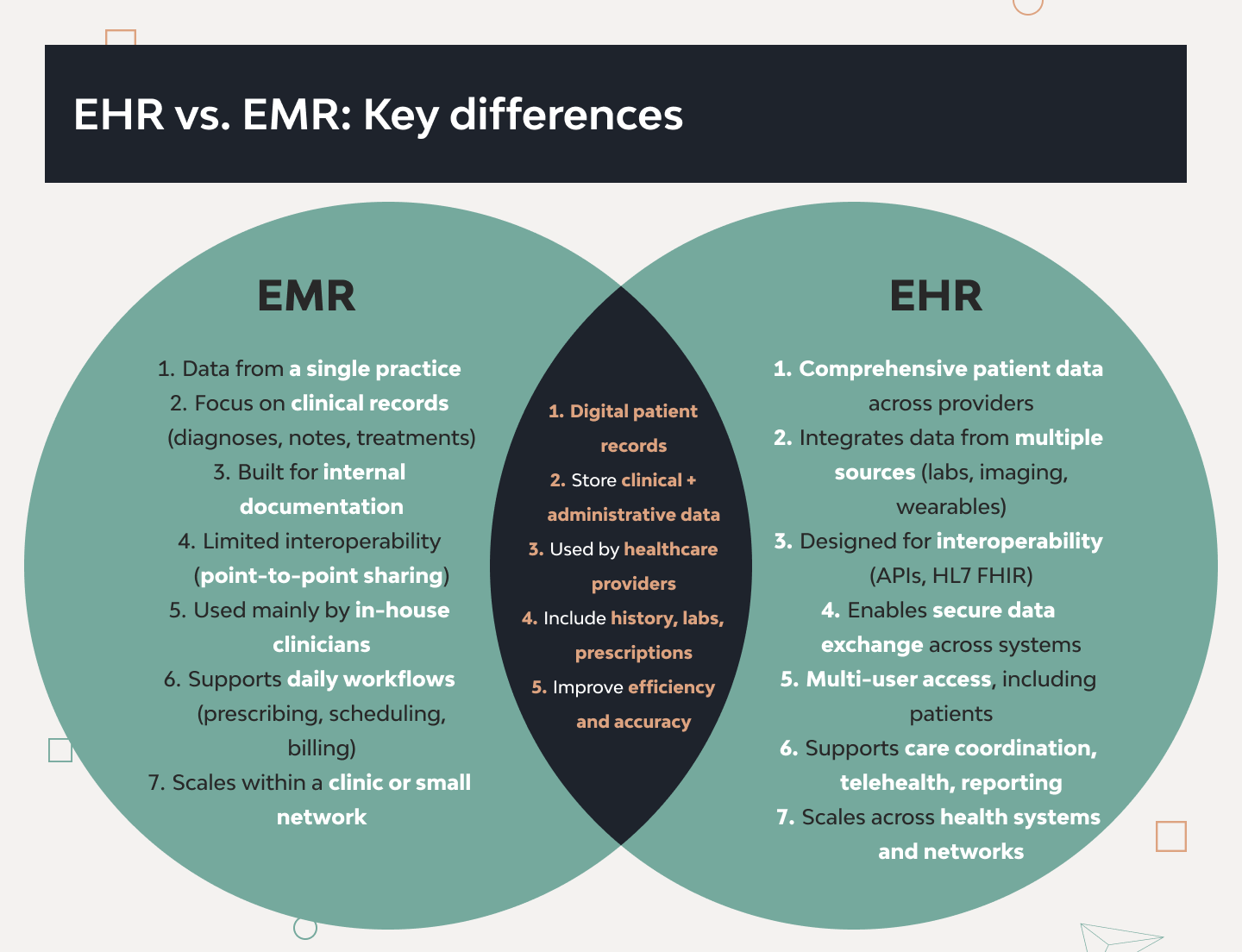
EHR vs. EMR: Key differences
To get the fullest picture of all the specifics, we shall review the main differences inEHR/EMR software development by aspect.
Data scope
EHR: EHR systems are built to store and represent broad patient data across all medical touchpoints and multiple healthcare settings. An EHR system pulls data from different sources and makes it useful beyond the original organization. This data may include medical history, lab results, imaging, allergies, prescriptions, and even readings from wearables. But it may also extend to administrative data and reporting, e.g., radiology reports, demographics, and meds resolutions.
EMR: EMR platforms usually contain records generated by a single organization. The data scope is similar to the EHR’s but narrower and may include diagnosis histories, treatment plans, and clinical notes. During EMR implementation, developers optimize a system for internal documentation with a single source of truth. So while the EMR is still good for day-to-day documentation, it isn’t designed for ecosystem-wide data exchange.
Interoperability
EHR: In EHR software development, interoperable performance is a must, enabling secure data exchange with institutions, patient/clinic apps, or payer systems. For this, developers use data-sharing standards, such asHL7 FHIR, and APIs. For instance, in the US, regulations promote standardized APIs and patient access, makingHL7 FHIR a common regulatory foundation for healthcare data-sharing solutions.
EMR: Many EMRs can export records, but usually in a “point-to-point” format only. They are not intended for large-scale interoperability and usually connect only within internal departments (e.g., a clinic’s lab) to exchange results from an individual medical practice. EMR architectures are thus more oriented towards individual and summary records than towards cross-institutional data in bulk.
Accessibility
EHR: EHRs enable multi-role access to centralized patient data for authorized users from multiple organizations. For this, an EHR may use permissions (e.g., to grant different levels of access to physicians, nurses, pharmacists, and accountants). Many EHR programs also enable patient-facing data access, allowing users to check their data remotely via cloud or a smartphone application.
EMR: EMR data access is usually limited to clinicians working with a specific medical case. Again, the EMR implementation is for internal use—clinicians can use it to view the patient’s chart, write a note, place a medication order, generate a prescription, etc. Collaborative features are also limited to internal data sharing and export. For patients, EMRs can generate printouts and record-specific online views.
Use cases
EHR: Typical EHR cases empower functionality beyond just record-keeping or data storage. EHR platforms can support hospital networks, telehealth providers, and government health systems. They can enable coordinated healthcare (e.g., referrals or transitions of care), public health reporting, and multi-provider collaboration. EHRs are also the backbone of telehealth and connecting and powering remote monitoring and AI-based tools.
EMR: EMR integration solutions are ideal for small- to medium-sized clinics that primarily need fast documentation, e-prescribing, scheduling, and billing. EMR systems can thus help fully process individual patient records. Medical facilities can leverage EMRs to reduce paperwork and automate workflows related to patient registration, monitoring, and updates.
Scalability
EHR: EHRs must necessarily scale across multiple departments or facilities. This is why EHR use cases tend to support configurable workflows, user role hierarchies, and advanced governance. Furthermore, EHRs must scale not only for higher user counts but also for greater operational complexity: as patient data travels across different care settings, the EHR system must handle identity matching, consent logic, and consistent terminology.
EMR: EMRs may scale facility-wide if the demand is there, but they don’t usually require enterprise-level expansion. The EMR may need extensions when a clinic adds locations, merges with other facilities, or needs deeper-level data exchange. In that case, developers may integrate additional interfaces, rework permission levels, explore audit trails, and improve data normalization.
Looking to modernize healthcare operations with custom software?
Consult with DjangoStars about the viability of your future EMR/EHR solution.
Cloud-based systems: Hosted by a vendor on a user-ready infrastructure with remote access and server-side maintenance. The cloud is fast to launch and easy to scale, but entails possible data and vendor risks (popular for electronic health record software solutions)
On-premise systems: Installed locally and powered by the facility’s own servers, giving clinicians fuller control over data. This allows for highly customizable, tight-knit systems but also requires an IT admin and maintenance (a common feature in EMR implementations).
Hybrid models: Local systems with cloud modules, e.g., an EMR integrated with analytics or a patient portal. A hybrid system retains reliable on-site data storage, expanding it with cloud flexibility.
Specialty-specific solutions: Systems tailored for cardiology, dentistry, mental health, pediatrics, and other niche fields. Such systems are pre-optimized, usually featuring field-specific templates and tools.
Hospital vs. small practice systems: Choosing between EHR and EMR software development, keep in mind that EHR is better for interoperable, multi-department workflows. EMR is a good fit for smaller practices that need speed and simplicity.
Core features of EHR and EMR software
Patient management: EHR/EMR software developmentprioritizes patient data above all else. Both types of software may require features for clean, centralized data intake and normalization, including patient registration, insurance verification, demographics summaries, statistical dashboards, and accounting per user.
Clinical documentation: Another core task for EHR or EMR software developers is to digitize all paperwork to enable structured, free-text patient data charting. This requires templates and charting, as well as SOAP notes—standardized medical documentation forms. Voice recognition is another trendy feature that speeds up data entry for specialists.
E-prescribing: Especially relevant for EMR software development, efficient e-prescribing requires medication history tracking and external integration with pharmacies. When implemented end-to-end, you can automate the generation of prescription printouts, ensuring they arehighly accurate and sent on time.
Appointment scheduling: Features like calendar management, integrated scheduling, and automated reminders help keep appointments on track. Automated SMS or email reminders reduce patient no-shows. On top of that, coordinated scheduling provides precise treatment and service details to patients (e.g., appointment rooms, directions, self-rescheduling links, etc.).
Billing and revenue cycle management: Payment processing engines, claims management tools, and medical coding (ICD-10, CPT) improve the transparency of financial operations. Well-integrated EHRs and EMRs can easily handle precise billing, reimbursements, and other patient-facing payments. This helps avoid unbilled services and risky claim submissions.
Lab and imaging integration: Clinics and healthcare organizations typically connect EMR/EHR systems to facilities that generate data, such as laboratories. To pull results into charts, the system requires diagnostic results management, protected data sharing, and integration with external labs.
Patient portal: Prevalent in EHR software development, patient portals enable access to records, self-care, appointment booking, and secure messaging with specialists and doctors. Patients can use portals to get treatment summaries, results, and notes online, as well as book individual caregivers and connect with them.
Reporting and analytics: EHR/EMR medical software can generate a wealth of insightful reports and analytics. An EMR or EHR developer must ensure clinical reporting tools, financial reporting, and population health management.
Benefits of EMR/EHR systems
Improved clinical efficiency
EHR/EMR systems enable faster access to patient records and medical history, minimize paperwork and manual data entry, and enhance clinical workflows across the board. Instead of searching through fragmented files or re-entering repetitive data, clinicians gain instant access to structured patient profiles, lab results, and diagnoses.
Enhanced patient care
Tailored EHR and EMR software development can help improve overall data visibility and coordinate patient care between different physicians. A platform will highlight medications, allergies, previous treatments, and diagnostic trends. EMR/EHR can automatically flag drug interactions, duplicate prescriptions, and allergy risks, keeping all doctors on the same page.
Better data management
EHR/EMR platforms centralize data into unified records that update in real time. With a well-customized platform, an organization can build its own dynamic data ecosystem rather than struggle with static charts. E.g., integrated analytics tools can turn raw clinical data into performance dashboards, population health insights, and predictive reports.
Regulatory compliance and security
High-quality EHR or EMR software development puts compliance at the core. Platforms usually include HIPAA and GDPR compliance out of the box and offer role-based access to data views. EHRs/EMRs may also feature audit trails that log all user interactions, data encryption, and additional integrations or protocols for highly secure authentication.
Cost optimization
A well-integrated EHR/ERM system enables transparent, error-free billing, claims processing, and automated reimbursements. EHRs/EMRs can reduce costs further throughdigitization, automation, and optimized workflows. But their greatest value lies in the increased diagnostic accuracy they provide, which can be critical in some cases.
Patient engagement
EMR or EHR software development is a proven way to reach more patients, serve diverse demographics, and simplify self-care access for everyone. A patient portal or a mobile app can help any future or existing patient view their test results, schedule doctor appointments, request prescription updates, and even contact remote professionals.
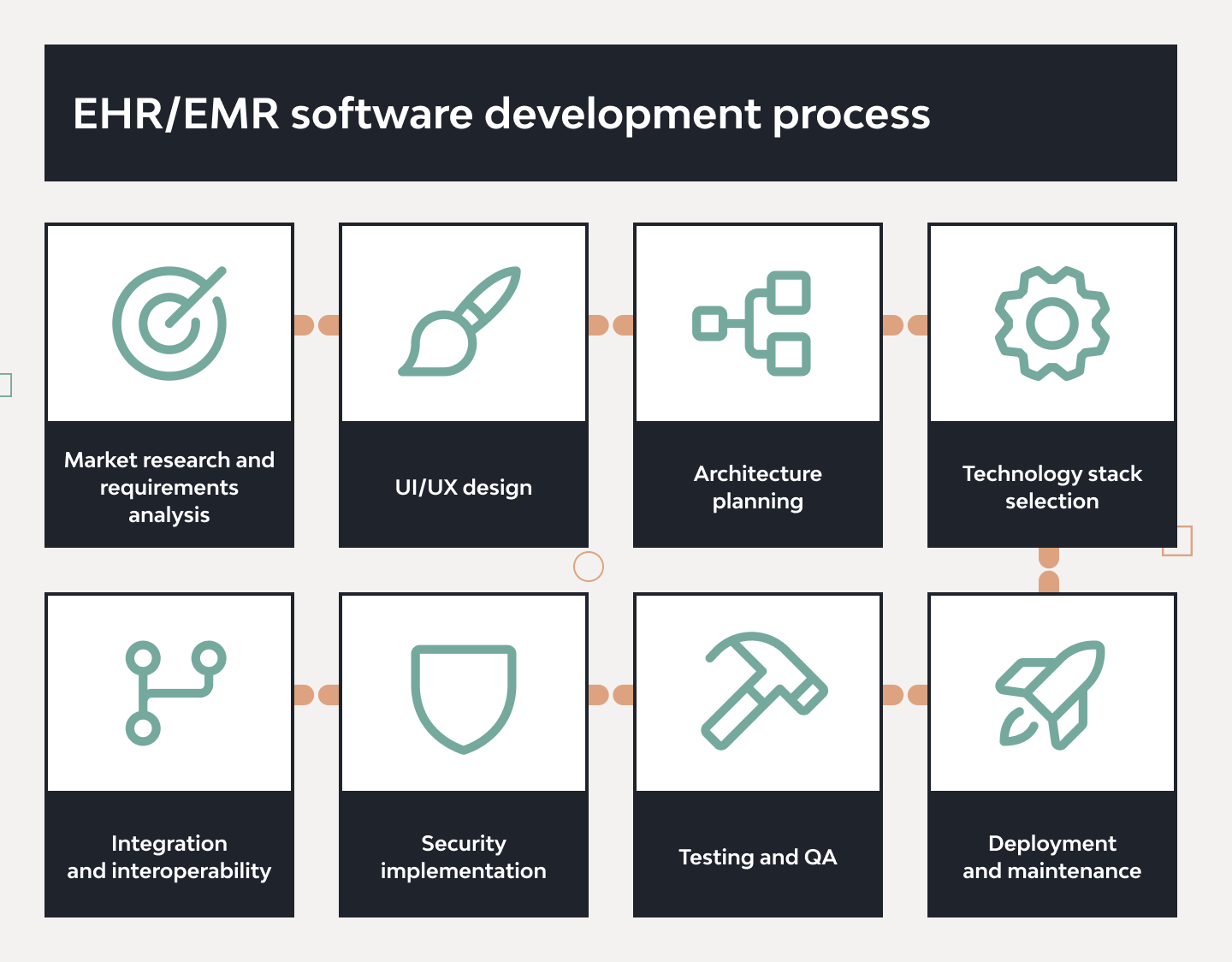
EHR/EMR software development process
Market research and requirements analysis
To understand how to create EHR software or EMR infrastructure that will meet its end goals, you should first identify the target users (clinics, hospitals, and telehealth providers). Start by mapping future patient journeys and workflows, conducting competitor analysis, and gathering requirements.
UI/UX design
The healthcare UI/UX should help avoid cognitive overload and maximize usability for clinicians and patients. An EHR/EMR interface must ensure clarity, simple navigation, accessibility standards, and workflow optimization through automation and feature segmentation.
Architecture planning
This is where you will need to choose—microservices vs. a monolithic structure or cloud infrastructure vs. on-premise database design. The choice depends on your EHR/EMR software implementation priorities: Do you need a remote EHR (hosted elastically in the cloud) or an internal EMR (hosted securely on-premise)?
Technology stack selection
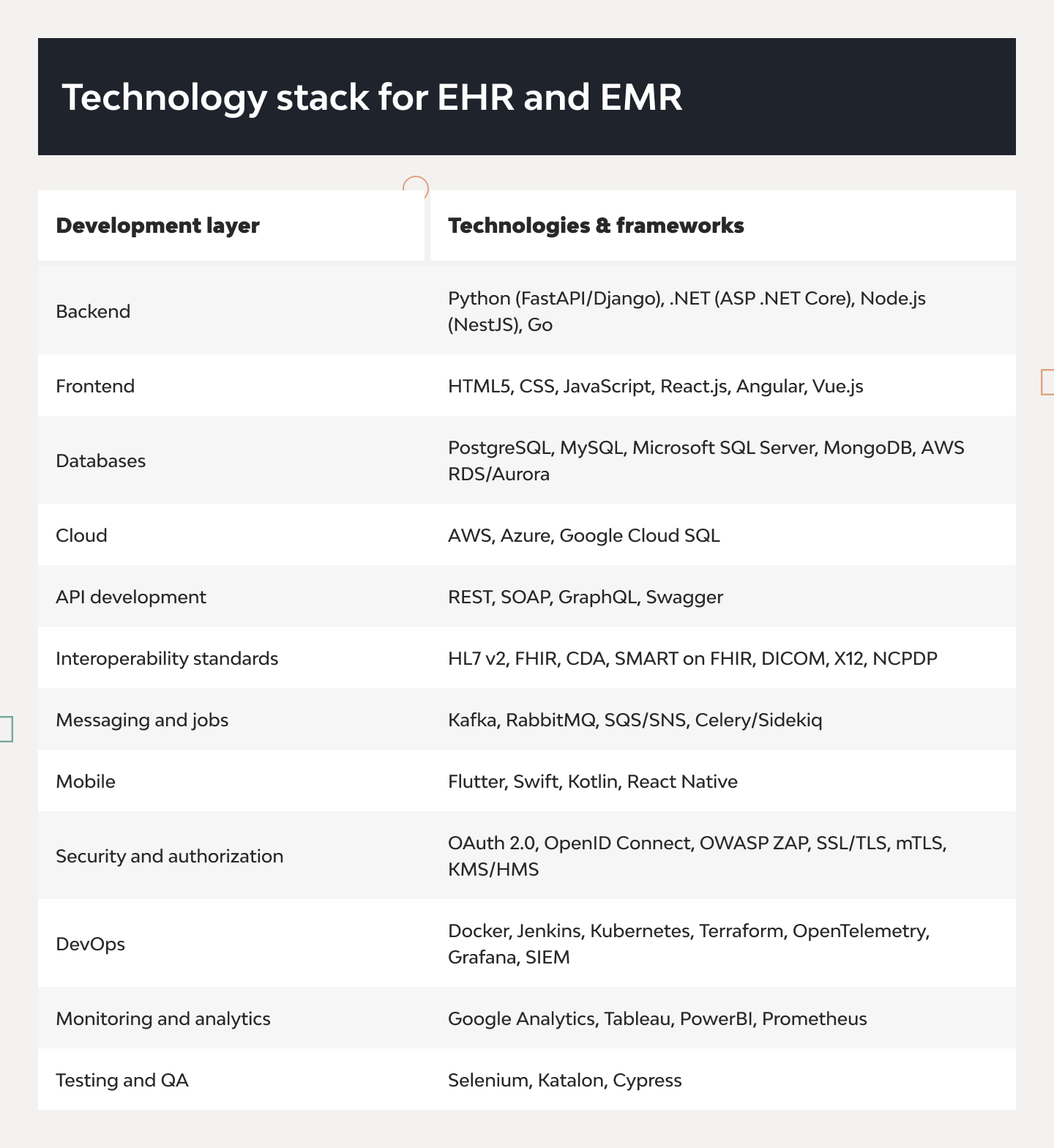
The right tech stack sets a reliable foundation for EHR/EMR software development. Make sure to pick responsive frontend frameworks and secure backend technologies that were tested in the market (see below). If you are considering cloud providers, check their geographic hosting requirements.
Integration and interoperability
You will probably need to integrate the future EHR/EMR system with a lab, pharmacies, or connected medical devices. If you plan third-party integrations and interoperability, prioritize HL7 v2 and FHIR standards, and keep all custom API development well-documented for compliance.
Security implementation
Healthcare software requires data protection and cybersecurity on multiple levels. To protect sensitive patient data, you will need to enable encryption both at rest and in transit. And to ensure the software users access only the features they need, use role-based authorization and audit logs.
Testing and QA
To polish and finalize software, use several testing scenarios: functional testing and QA to validate workflows and usability; performance testing to assess stability under high user loads; security testing to identify vulnerabilities; and compliance audits to ensure legitimacy.
Deployment and maintenance
To deploy the finished software iteratively and perfect it gradually, use CI/CD pipelines for controlled, secure EHR/EMR releases. You should also take care of post-launch monitoring (to spot emerging performance issues) and ongoing updates (to fix the issues and maintain compliance).
Ready to launch your next healthcare platform?
DjangoStars helps organizations design and develop EMR/EHR systems from scratch.
Your tech stack dictates the success of your EHR/EMR software development cycle. Below is the ultimate list of EHR and EMR technologies you may use for development at any scale.
Challenges in EHR/EMR software development
Complex clinical workflows: Healthcare can be complicated and unpredictable. It’s important to prepare a new EHR/EMR software solution for urgent add-ons, overrides, and custom orders. A new system must also support parallel workflows for different users/departments.
User adoption resistance: It doesn’t matter how high the quality of EHR/EMR software developmentis if clinicians or patients resist using a novel solution. It’s crucial to incentivize end-users with good onboarding, intuitive UI/UX, project involvement (e.g., polls), and feedback reactions.
Integration with legacy systems: Many hospitals still run older lab, radiology, and billing tools, with data exchange through HL7 v2 feeds. If that’s the case, new interfaces may require more in-depth mapping and monitoring to avoid downtime.
Regulatory changes: Healthcare regulations expand—data access requirements, certification criteria, and reporting obligations change. It’s important to create EMR or electronic health record software solutions with traceable, auditable processes.
Cybersecurity threats in healthcare: Healthcare’s sensitive data is an easy target for cyberattacks. To avoid that, you will need secure infrastructure, encrypted data sharing, proactive monitoring, and mature incident response.
Ransomware risks: Ransomware attacks can block access to patient records. To prevent this, watch out for exploitable endpoints, outdated services, and poor credential management. Prioritize regular backups and real-time threat detection.
Secure API design: APIs enable interoperability but also expand the attack surface.. API design must be secure, with encrypted endpoints, rate limits, reinforced client authentication, and regular vulnerability testing.
Zero-trust architecture: To secure your EHR or EMR software development for the long term, avoid outdated perimeter-based security models. Use zero-trust architecture instead, which requires verifying, authenticating, and authorizing every access request.
How much does EMR/EHR software development cost?
Cost depends on scope, integrations, data migration needs, and the range of compliance. Custom EMR/EHR software development services may cost significantly more than integrating a ready-made platform or connecting to a cloud database.
To give you an approximate practical cost range:
A lean MVP for a single specialty (e.g., charting, scheduling, basic billing) often costs $50k–$150k.
A multi‑provider product with interoperability (FHIR/HL7), lab and imaging interfaces, a patient portal, and revenue cycle automation typically falls in the $150k–$500k range.
Enterprise hospital solutions that include complex integrations, large-scale data conversion, and high-availability operations can exceed $1M and may reach several million.
Make sure to also budget for system rollout and maintenance: training, support, monitoring, and interface upkeep are most commonly long-term costs.
Emerging trends in EMR/EHR software development
AI-powered clinical decision support
AI enables analytical assistance and data-driven decision support. It rapidly analyzes clinical datasets, suggests diagnoses, and recommends treatments.
Predictive analytics
EHR EMR software can use machine learning to predict health risks and complications from historical and integrated data. This allows for more proactive treatments.
Telehealth integration
Virtual care allows patients to avoid unnecessary in-person doctor visits. It includes video consultations, remote patient monitoring, e-prescribing, etc.
Mobile-first EHR
Keep EHR/EMR software development mobile-oriented. Millions of patients prefer to view their records and lab results on a smartphone.
Blockchain in healthcare
Clinics increasingly leverage blockchain. In EMR/EHR development, it helps deepen health data protection through decentralization and immutability.
Patient-facing portals and apps
Online portals and mobile apps enable patients to access data, schedule appointments, and message their providers. Telehealth and remote self-care are currently on the rise.
How to choose the right software development partner
Creating a usable EHR/EMR system is much simpler and cost-efficient with the help of a healthcare software development services provider. To ensure that we are the right technology vendor for you, we at DjangoStars offer the following advantages.
Industry experience
DjangoStars is a seasonedEHR and EMR software development companythat understands clinical roles, healthcare revenue cycle basics, regulatory obligations, and clinically safe UX practices. We ensure a match of technical skills and domain experience as a healthcare and medical software provider.
Compliance expertise
Medical data is among the most sensitive categories of information, so you need proven compliance and proven options. DjangoStars is a qualified development partner with multiple ISO certifications and strong expertise in healthcare regulations, including HIPAA, GDPR, and regional data protection frameworks.
Proven track record
It’s best to choose an EMR/EHR software development services provider that has created data management systems for healthcare. For instance, DjangoStars proves reliable with a portfolio that includes several successful cases completed in complex healthcare environments.
Security-first approach
On top of adhering to all relevant compliance and security standards, we also employ zero-trust architectural models and leverage proven technologies. With a track record of working in high-risk and formal industries, DjangoStars knows how to protect data and software.
Post-launch support
Last but not least, the DjangoStars team maintains a system after its deployment and launch, monitoring its performance and providing fixes and iterative improvements. And we are always ready to scale the EMR/EHR software developmentlifecycle.
Planning to build a secure and scalable EMR or EHR solution?
Partner with DjangoStars to develop a reliable EMR/EHR system tailored to your clinical workflows.
What is the difference between EHR and EMR systems?
Electronic Medical Record systems are for internal record management: EMRs digitize patients’ charts in a single healthcare organization, usually a smaller-scale practice or private clinic. Electronic Health Record systems are for centralized patient data access: EHRs share data across multiple healthcare providers, serving as a single source of truth. EHRs are also more often patient-facing, offering online charts or telehealth features.
How long does it take to develop EHR or EMR software?
The timeline of your EMR/EHR development cycle is very individual and depends on the scale of data, integrations, and custom workflow design. A very basic app or an MVP can take 6–9 months. A medium-scale system with some custom coding may take 9–15 months. As for an enterprise-grade EHR or EMR system, expect to spend 12 months to several years.
How much does EHR/EMR software development cost?
Many individual factors and development decisions affect the final cost of your EHR/EMR software, including features, integrations, and security to the scale of maintenance, the type of hosting, the scope of compliance, etc. On average, a simpler app or an MVP costs $80,000–$150,000. A mid-sized EMR or EHR system development is in the $150,000–$400,000 range. And a custom enterprise-level platform may cost up to $500,000+.
Can EHR/EMR systems integrate with third-party healthcare platforms?
Yes. An up-to-date EHR/EMR system uses interoperability standards (e.g., HL7 v2 and FHIR) and APIs. That allows them to integrate with more external data sources and other facilities, such as labs, pharmacies, insurance systems, and telehealth platforms.
What regulations must EHR/EMR software comply with?
Any viable EHR/EMR system must handle PHI—protected health information—securely and legally. It’s crucial to meet regulatory standards in respective regions: HIPAA and the HITECH Act in the USA; GDPR in the EU; and HL7 and FHIR interoperability standards for all.
What security measures are required for EHR systems?
Healthcare generates a lot of highly sensitive data that EHR/EMR software must protect. For this, your future system should feature end-to-end encryption (for data in transit and at rest), role-based access control, multi-factor authentication, audit logs, monitoring, regular security testing, and vulnerability assessments.
Views:1,009
Table of content
Want to start a project ?
Hire experienced developers to build your next project with DjangoStars
We store cookies on your computer. We use these cookies to collect information about how you
interact with our website and remember you. We use this information to improve and customize your
browsing experience and for analytics and metrics about our visitors both on this website and other
media. To find out more about the cookies we use, check our Privacy Policy.
Subscribe
to our
newsletter
Thanks for
joining us! 💚
We’ll let you know, when we got something for you.