Shipment Tracking Software Development: A Complete Guide


Real-time shipment tracking software allows businesses with supply chains and deliveries to monitor their shipments by stage, from pickup and transit to the final destination. By providing a feature-rich and customizable GPS shipment tracking platform, companies can achieve far more accurate ETAs, faster delay response, and personalized customer updates.
Most importantly, real-time shipment visibility gives logistics teams a broad view of locations, statuses, route progress milestones, expected delivery times, and more.
Retailers and e-commerce businesses, freight and transportation companies, manufacturers and distributors, logistics providers, and more shipment-focused businesses can leverage custom shipment tracking solutions.
This guide explores the types and benefits, who needs them, and how to develop shipment tracking software that runs stably and delivers high ROI.
What is shipment tracking software?
Shipment tracking software is a range of specialized digital tools and solutions for logistics, transportation, and supply chain operations management. This software takes your usual GPS shipment tracking to a higher level of precision, automation, and overall efficiency.
Shipment tracking software can take various forms, but its main purpose is to collect, process, and display data about shipments as they move through the supply chain. Unlike transportation management systems, shipment tracking software focuses on the shipment itself rather than dispatch and freight execution.
However, it can be customized to fit any required purposes. For instance, custom shipment tracking software development allows you to break out of vendor constraints and standard features for a conventional logistics workflow. With a custom software approach, you can tailor functionality, integrations, and user experiences to what you want for your brand.
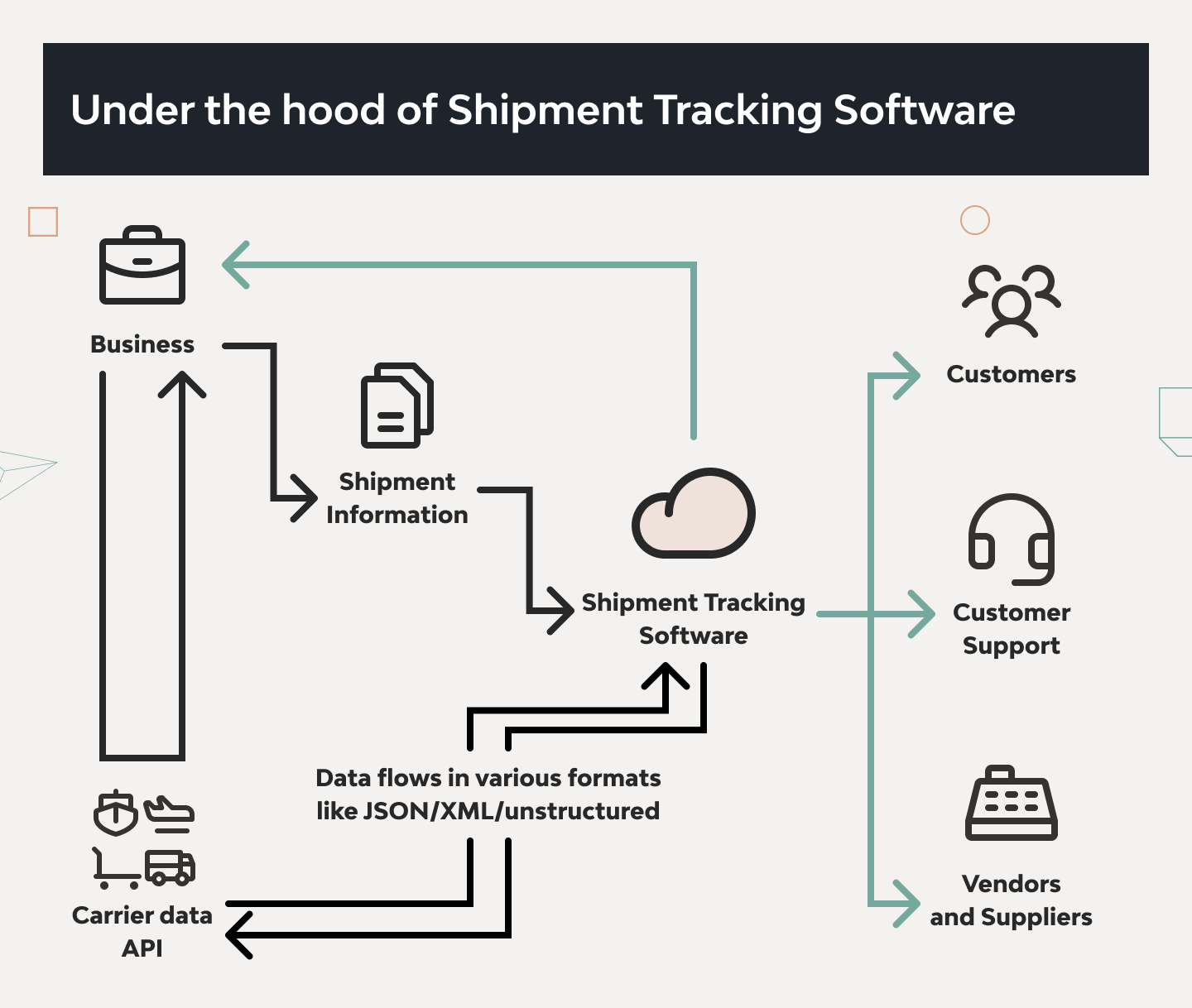
How shipment tracking software works
Shipment tracking software provides a structured system for stage-by-stage processes:
- Shipment data collection – Tracking software gathers all the core information you need to identify and manage a shipment. It tracks order details, tracking numbers, carrier data, pickup information, delivery addresses, and more. This data helps create a unified shipment record that can be updated as the order moves through the logistics network.
- GPS, carrier, and IoT data transmission – Multi-carrier tracking software pulls movement and status data from connected GPS devices, carrier APIs, telematics systems, IoT sensors, and mobile applications. These integrations allow the platform to capture information from vehicles, carriers, warehouses, and individual shipments without requiring manual status updates.
- Real-time location processing – The software processes incoming data in real time, showing where a vehicle or shipment is and how it is progressing along its set route. It can then combine vehicle coordinates, shipment status, route progress, geofence events, and cargo conditions for a more complete picture of the shipment’s current state.
- ETA calculation – Estimated time of arrival calculation can be automated via shipment tracking software. For that, the system combines the shipment’s current location with factors such as traffic conditions, route distance, delivery schedules, and historical data. As conditions change, the system can recalculate the ETA and flag potential delays.
- Status updates and customer notifications – With a tracking system, each major shipment milestone, from pickup and transit to out-for-delivery and arrival, can trigger an automatic status update. The software can also send delay alerts, revised ETA updates, email notifications, and SMS messages for customers, dispatchers, or other stakeholders.
- Delivery confirmation and reporting – You can know precisely when the shipment reaches its destination with dedicated tracking software. The system records electronic proof of delivery and stores signatures, delivery photos, and the complete shipment history. Based on this info, the system can produce performance reports showing delivery accuracy, delays, and overall logistics efficiency.
Types of shipment tracking software
Shipment tracking software can vary in form and architecture based on your scale of operations, area of application, and/or technology:
- Real-time shipment tracking systems – These are usually AI shipment tracking software solutions designed to provide live shipment location, status updates, and ETA tracking. Automated delay alerts and interactive maps additionally help logistics teams and customers track potential shipment disruptions or progress milestones.
- GPS-based fleet tracking software – GPS shipment tracking helps monitor primarily vehicles and fleet operations rather than individual packages. GPS systems integrate vehicle tracking, driver activity, route monitoring, geofencing, and fleet analytics, providing insights to improve safety and operational control.
- Multi-carrier tracking platforms – Multi-carrier tracking software connects carrier APIs and consolidates shipment information from multiple logistics providers in one interface. The resulting unified tracking, status synchronization, exception management, and shipment analytics give businesses a consistent view of orders, no matter which carrier handles them.
- Last-mile delivery tracking software – These systems are designed for the final stage of delivery;they prioritize shipment timing and customer visibility. Last-mile systems also enable courier tracking, delivery scheduling, customer notifications, ETA updates, proof of delivery, and more features that coordinate drivers and keep shipment recipients informed.
- Freight tracking systems – Freight-optimized systems help monitor larger shipments and loads as they move between facilities, terminals, and destinations. In addition to tracking freight location and load status, these systems can generate exception alerts based on carrier monitoring and delivery milestones, helping manage delays and disruptions.
- Container and maritime tracking software – Specialized tracking platforms can provide visibility into ocean freight by delivering exact container location data and syncing it with vessel and port updates. Businesses can use this to monitor vessel movements, customs status, and cargo conditions, optimizing their delivery across international supply chains.
- Air cargo tracking solutions – These tracking systems help follow shipments throughout the air freight process, from airline handling to customs to delivery finalization. They help gain end-to-end visibility of time-sensitive cargo, specifically through flight tracking, airway bill status, customs clearance, handling updates, and real-time delivery notifications
- Customer shipment tracking portals – Customer-facing portals give shipment recipients direct access to shipment information without contacting support. Depending on the platform’s depth and breadth of functionality, users can view order status, live tracking maps, delivery estimates, shipment history, as well as set custom notification settings from a branded web interface.
- Mobile tracking apps for drivers – Specialized apps turn a driver’s smartphone or connected device into a field-level tracking and reporting tool. Alongside GPS navigation and route updates, drivers can submit status reports, upload documents, and record delivery confirmation right from the road.
- White-label shipment tracking platforms – This type of platform allows logistics companies and other businesses to offer tracking capabilities under their own brand instead of developing the entire system from scratch. White-label systems usually offer tools for custom branding and configurable workflows, customer portals and carrier integrations, and analytics dashboards tailored to individual operations.
Key shipment tracking software features
Shipment tracking software can have varying sets of features, but the essential and highly useful capabilities to implement include:
- Real-time GPS tracking – GPS provides live location, vehicle coordinates, route progress, and movement history so logistics teams can see where a shipment is at any given moment.
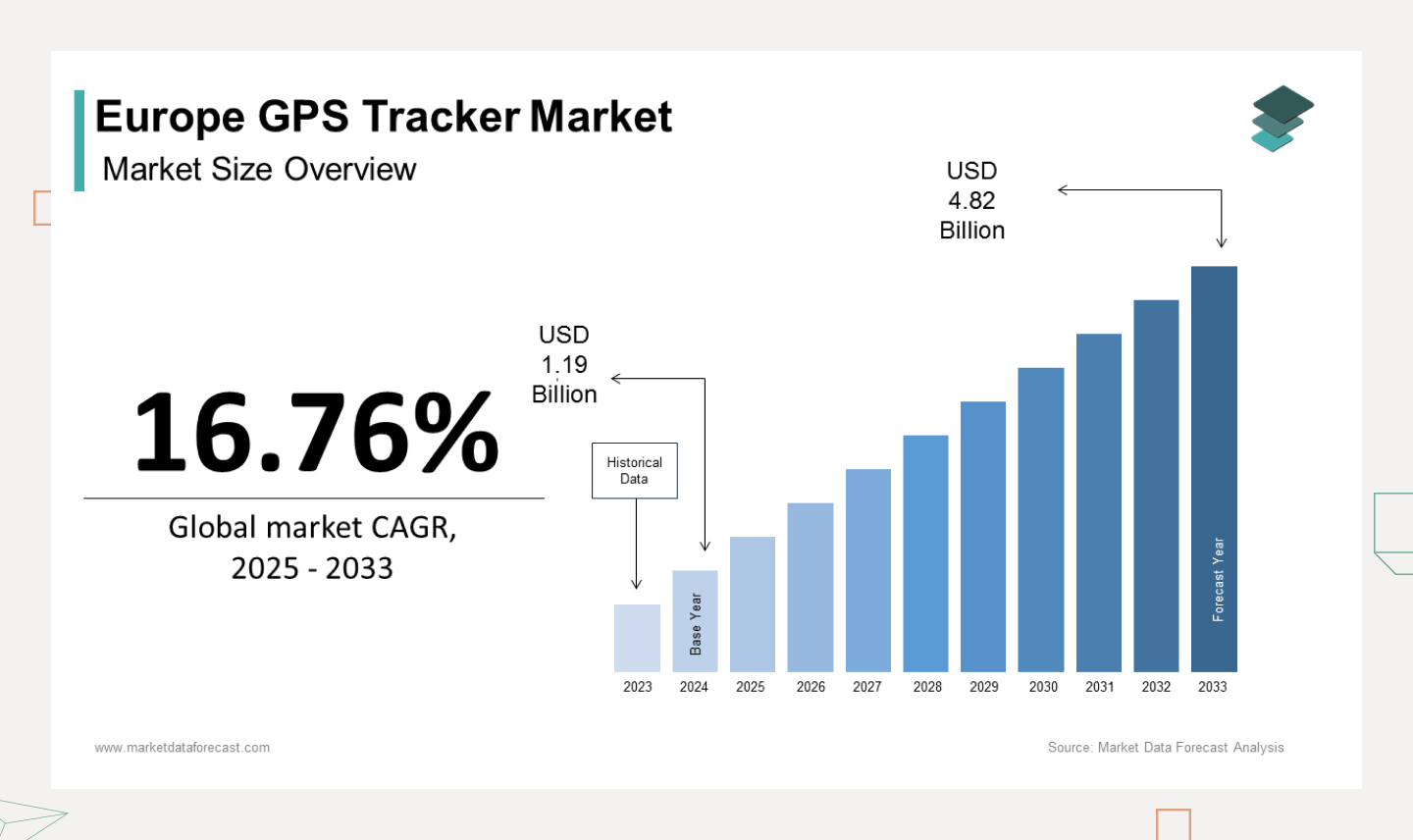
- Interactive shipment maps – smart and configurable maps help visualize shipment location, planned routes, delivery stops, and relevant traffic data in a single view accessible across devices.
- Automated status updates – shipment tracking software automatically records key events such as pickup confirmation, in-transit updates, arrival status, and delivery completion without manual reporting.
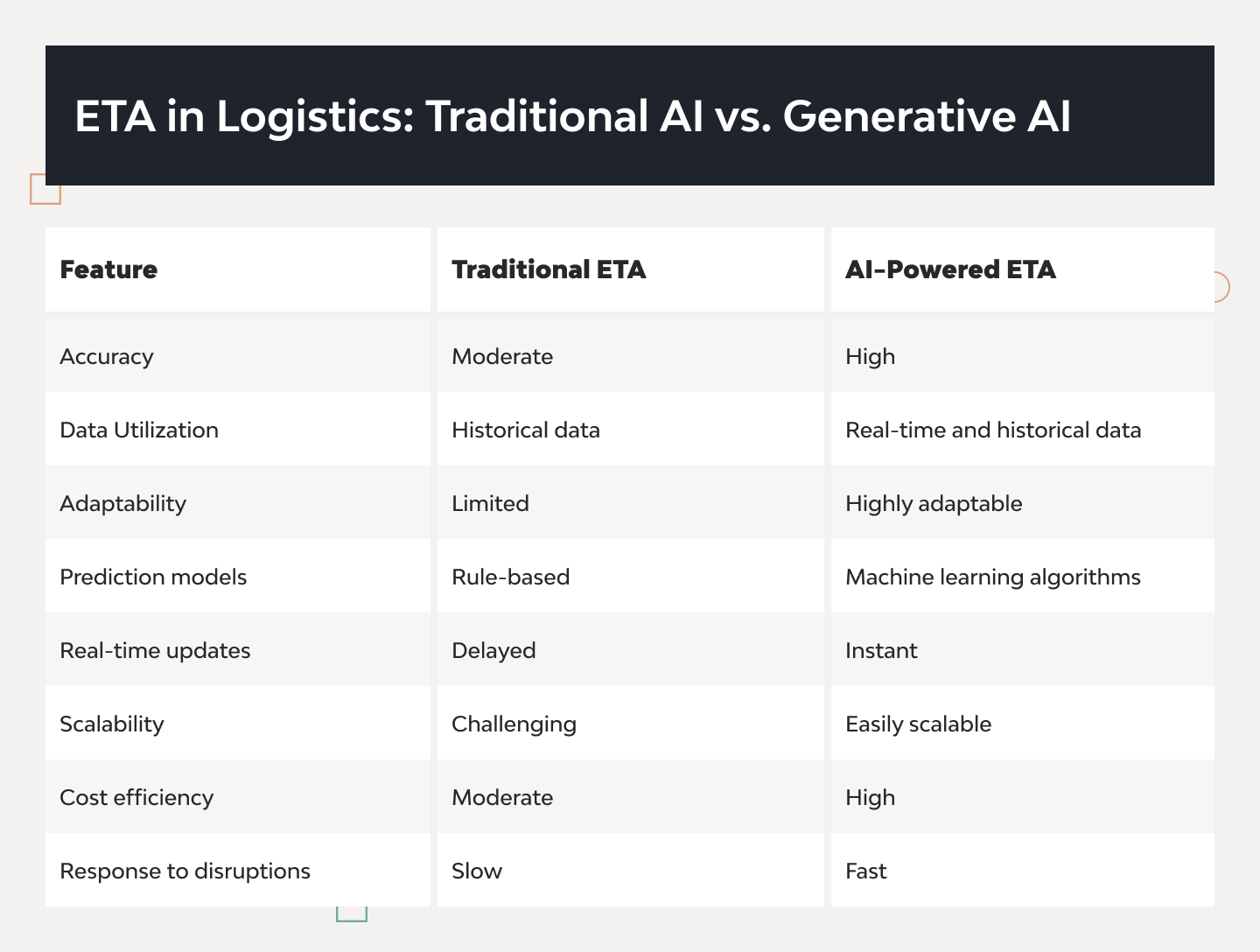
- ETA prediction – specialized software can analyze traffic conditions and route distance against historical data and generate accurate delivery schedules, allowing teams and customers to estimate a shipment’s arrival.
- Route monitoring – a tracking system can compare your planned routes with actual vehicle/shipment movement, spot route deviations, track stop progress, and highlight delivery sequences.
- Geofencing – geofencing technology can create virtual zones where departure alerts, arrival notifications, and other location-based actions are triggered automatically based on pre-set positioning.
- Multi-carrier tracking – multi-faceted systems connect and sync up different carrier APIs to enable unified tracking, synchronized shipment statuses, and full visibility into carrier performance.
- Proof of delivery – built-in proof-of-delivery mechanics enable shipment tracking systems to efficiently capture and store digital signatures, delivery photos, timestamps, and even recipient confirmations for successful handoff documentation.
- Driver mobile applications – mobile shipment tracking allows integrating GPS navigation with live status updates, document uploads, and delivery confirmation tools that can be used right in the field.
- Customer notifications – tracking systems can send shipment information to customers through SMS alerts, email updates, push notifications, and delivery reminders triggered at relevant stages of the shipment’s journey.
Benefits of custom shipment tracking software
Custom shipment tracking software can be adapted and leveraged by a business to smooth out and perfect its supply chain and deliveries through the following:
- Improved shipment visibility – Custom tracking software gives logistics teams and recipients anticipating their order a real-time view of the order’s location, its route progress, and relevant delivery milestones. This centralized outlook makes it easier to track shipments at every stage and spot issues even before the delivery is completed, which helps keep customers highly satisfied.
- Accurate delivery estimates – Dedicated tracking systems provide predictive ETAs by combining live traffic data, dynamic route conditions, and historical delivery insights to produce highly reliable arrival estimates. In turn, more accurate and predictable ETAs help logistics teams plan operations while customers get clearer expectations about final delivery times.
- Faster delay management – Automated exception alerts can highlight route deviations, missed deadlines, and other disruptions as soon as they occur. The system can also trigger automated notifications, allowing dispatchers to respond to minor delays early and prevent larger service problems for customers.
- Reduced operational costs – Route optimization and workflow automation achieved with shipment tracking software cut unnecessary mileage, manual work, and delivery errors. With fewer delivery errors and streamlined resource planning, businesses can use vehicles, coordinate drivers, and leverage other logistics resources at another level of efficiency.
- Better customer communication – Shipment software can provide customers with tracking links, status updates, delivery alerts, and proof-of-delivery notifications throughout the shipment lifecycle. This level of transparency reduces recipients’ uncertainty and can lower the total number of tracking-related tech support requests.
How to develop shipment tracking software
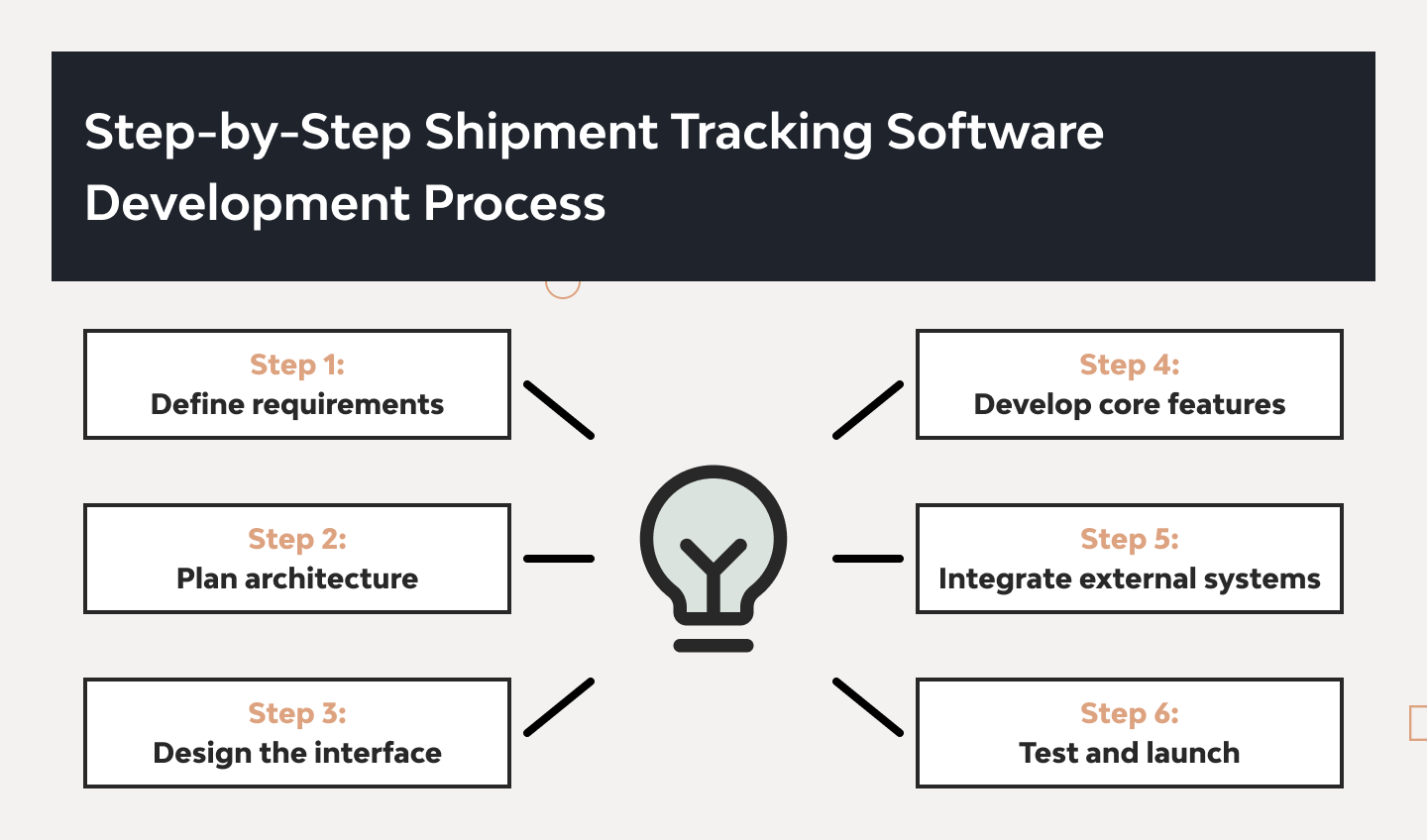
Here’s how to develop shipment tracking software step by step according to our own best practices:
- Step 1: Define requirements – start by setting business goals and defining the future software’s user roles, tracking workflows, and integration needs to establish a clear scope for the whole project right from the start.
- Step 2: Plan architecture – define the core system components, data flows, and API structure and decide between on-premise and cloud infrastructure based on your scalability needs and preferences.
- Step 3: Design the interface – create intuitive user dashboards and easy-to-use interactive tracking maps; implement mobile screens for future connected devices, and tailor customer portals to each user group (e.g., dispatchers, recipients, drivers, etc.).
- Step 4: Develop core features – build essential shipment tracking software features, such as real-time tracking, predictive ETA calculation, live status updates, and automated notifications synced with user profiles and events (e.g., shipment delivery milestones).
- Step 5: Integrate external systems – connect the platform with carrier APIs and integrate GPS services, ERP platforms, WMS, and TMS to collect and synchronize shipment data from across different logistics ecosystems.
- Step 6: Test and launch – make sure to validate the tracking accuracy, stress-test system performance, and conduct a thorough data security assessment before initiating software deployment and preparing for full launch.
Shipment tracking software integrations
The main shipment tracking software integrations that enable a continuous flow of shipment, vehicle, warehouse, and customer data include:
- Carrier APIs – Direct software connection with carriers feeds accurate shipment statuses, tracking numbers, delivery updates, and other carrier data straight to your tracking system. This can be used to consolidate information incoming from multiple carriers while keeping shipment records synchronized automatically.
- TMS and WMS – Integrations with Transportation and Warehouse Management Systems help connect the transportation/warehousing operations with shipment records and inventory data. This can coordinate shipments across dispatch, fulfillment, loading, and delivery while maintaining reliable data flow between different logistics systems.
- ERP and CRM systems – Enterprise Resource Planning and Customer Relationship Management integrations help sync up orders, customer data, payment invoices, and delivery information with shipment records. As a result, sales, finance, customer service, and logistics teams can share the same up-to-date information.
- GPS and telematics – Telematics and GPS are the necessary integrations for pinpointing vehicle location, tracking route progress, monitoring driver activity, and gathering fleet data. This information can be used to support accurate tracking, driver management, and fleet performance analysis.
- Mapping services – Map integrations will add route maps with additional elements, like traffic data, distance calculation tools, and geocoding capabilities, to your tracking platform. The smart, interactive maps you can integrate help optimize routes, improve ETA accuracy, and provide a clearer visual representation of shipment movement.
- IoT devices – IoT integrations help connect the tracking platform with temperature sensors, cargo condition monitors, and container tracking devices that capture shipment data autonomously. Real-time alerts can then notify logistics teams when conditions such as temperature, humidity, or container status shift outside safe thresholds.
Challenges in shipment tracking software development
While it’s certainly ripe with practical benefits, shipment tracking system development has its own pitfalls and potential hardships to overcome, like the following:
- Inconsistent carrier data – Different carriers may use different data formats, omit or miss important updates, or apply their own shipment status definitions, making it difficult to unify tracking information flows. You may need to battle shipment status mismatches and overcome API limitations while normalizing data and synchronizing carriers.
- Complex system integrations – Connecting carrier APIs, ERP platforms, TMS solutions, and warehouse systems requires careful handling of varying technologies, data structures, and integration rules. Poorly designed or configured integration can create data silos, synchronization problems, and extra maintenance work, especially when scaling.
- Real-time data processing – A tracking platform may need to process high data volumes and trigger frequent location or status updates, ideally without introducing noticeable system latency. The platform’s architecture must support continuous data synchronization and be scale enough to handle growing shipment and user volumes.
- Tracking and ETA accuracy – Reliable tracking and ETA calculations depend on GPS precision, dynamic traffic conditions, route changes, and the quality of historical data. Be aware that even small inaccuracies in location or shipment timing can produce misleading ETAs and undermine entire delivery planning.
- Connectivity issues – Weak mobile networks and remote locations can interrupt communication between shipment tracking devices, drivers’ apps, and the central platform. You will need to implement offline tracking and delayed synchronization mechanisms to preserve data continuity until the connection is restored.
- Data security – Shipment tracking platforms can handle operational, customer, and potentially sensitive location data that must be well protected across the system. This requires in-depth access control, data encryption, highly secure APIs, and applicable privacy compliance measures to prevent unauthorized access and data breaches.
AI in shipment tracking software
Artificial Intelligence powers a range of critical capabilities and features in shipment tracking software, mostly ones focused on automation or intelligent operations, including:
- AI-powered ETA prediction – AI enables real-time traffic analysis, automates historical delivery data, and acounts for route conditions to calculate more accurate shipment arrival estimates. As conditions change, dynamic ETA updates can automatically reflect new delays, traffic patterns, or route disruptions.
- Intelligent route optimization – When placed at the core of shipment tracking software, machine learning algorithms can evaluate routing options and recommend an optimal route based on distance, traffic, delivery constraints, and other operational factors. The system can also help optimize shipments through delivery sequencing, improving mileage, driving time, and fuel efficiency by intelligently breaking down routes and setting optimal stops.
- AI demand forecasting – AI can analyze historical data to predict future shipment volume and identify seasonal patterns or demand shifts. These insights can drive smart capacity planning and resource allocation, helping to more effectively allocate vehicles, drivers, warehouse space, and other resources.
- Predictive delay detection – AI models can be trained to recognize conditions that could disrupt the delivery;they analyze carrier performance, weather impacts, route deviations, and other operational signals. In turn, human logistics teams can receive early warnings and take action even well before the news of a delay reaches the customer.
- AI customer support chatbots – AI enables chatbots that can provide automated tracking updates, answer delivery inquiries, and assist with exception handling without requiring a human agent for every request. Furthermore, these chatbots can work around the clock, enabling 24/7 assistance with common inquiries and improving overall response times (while relieving workload on customer service teams).
- Automated anomaly detection – AI can continuously analyze supply chain patterns to spot unusual shipment activity, tracking inconsistencies, unexpected route deviations, or other potential risks. Early detection thanks to AI allows human teams to investigate suspicious or abnormal events before running into larger issues.
- Predictive fleet maintenance – AI can also analyze vehicle sensor data from IoT integrations along with historical maintenance records to identify equipment failure patterns. AI can thus tell in advance where you might need to fix or tweak the system, enabling maintenance scheduling, failure prediction, and overall downtime reduction.
Data security and compliance in shipment tracking software development
For long-term stable performance without legal disputes over data usage, your shipment tracking software must reliably secure real-time location data, customer details, delivery records, and carrier integrations, which can be achieved through:
- Data encryption
- Authentication and authorization
- GDPR compliance
- SOC 2 considerations
- Audit logs
- Secure API management
- Backup and disaster recovery
Shipment tracking software development cost
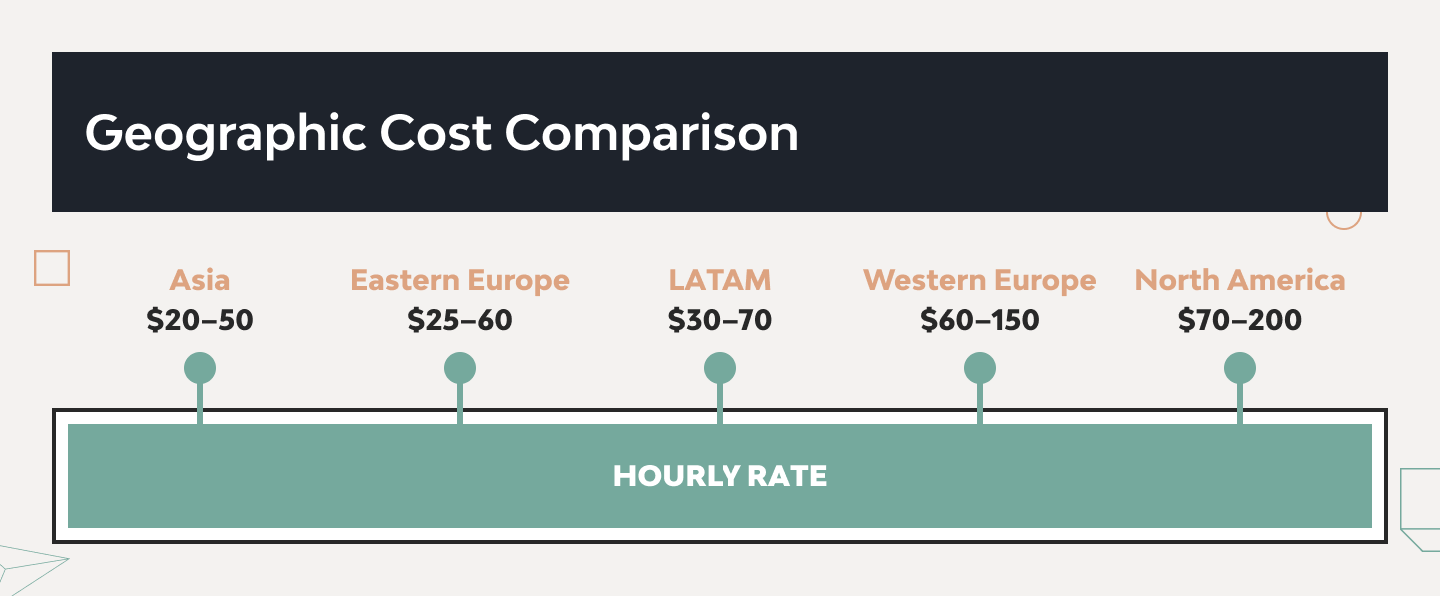
The final shipment tracking software cost is unique to every project, but you can calculate, estimate, and safely anticipate it if you know what affects the price.
Factors affecting cost
The main factors to keep in mind when estimating the shipment tracking software cost are:
– Platform complexity
– Number of integrations
– Mobile applications
– AI features
– Real-time infrastructure
– Custom dashboards
Estimated development costs
Your final cost will also vary based on the overall approach to the shipment tracking platform development and the expected system scale:
– MVP – $50,000-$150,000
– Mid-sized solution – $100,000-$500,000
– Enterprise platform – $250,000-$2,000,000+
Custom development vs. off-the-shelf software
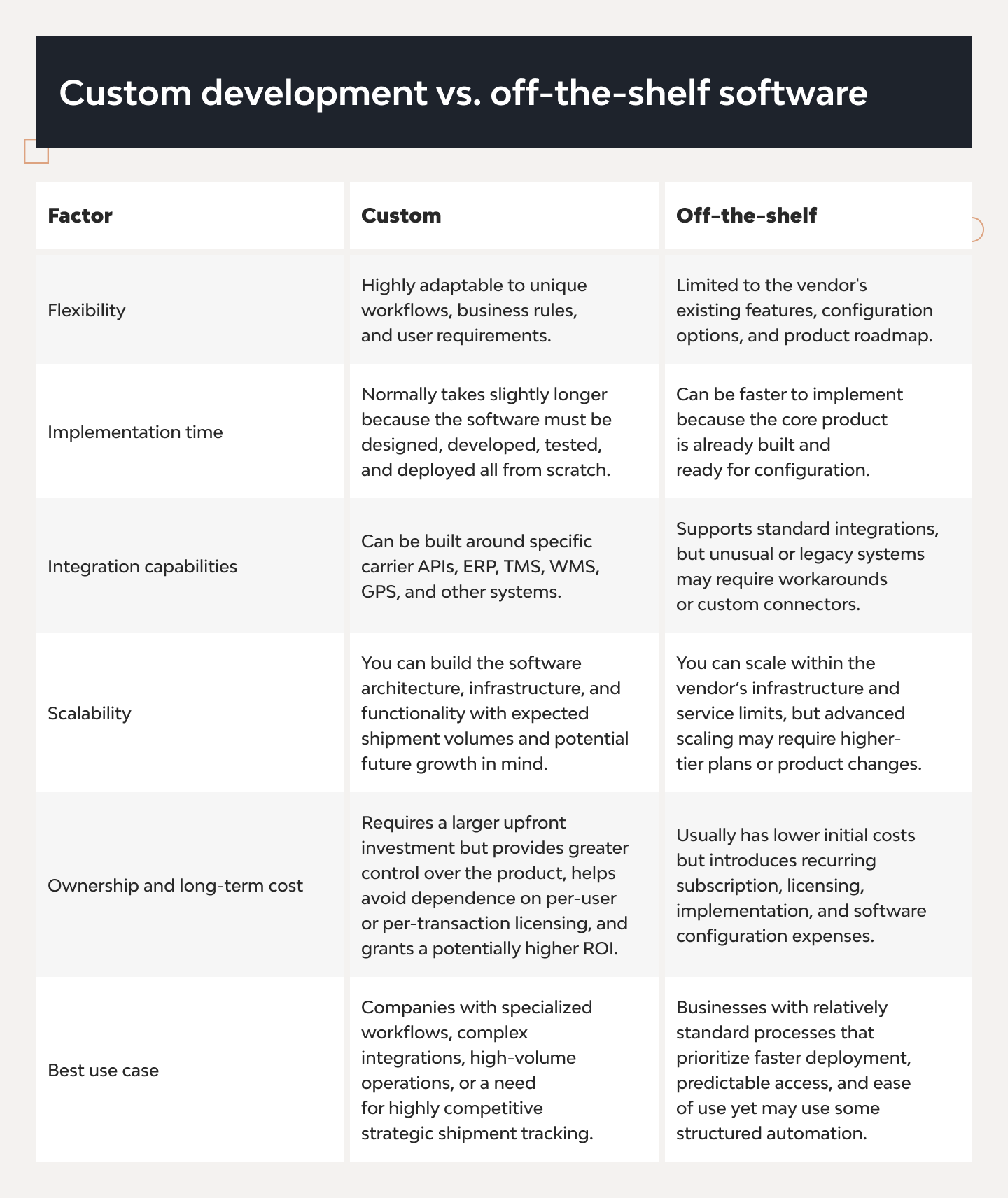
Custom shipment tracking software gives you flexibility and authenticity of operations, but either approach has its specifics, which might be fitting for different goals:
Why choose DjangoStars for shipment tracking software development?
- Logistics software expertise – With 18+ years of expertise, DjangoStars’ software engineers can build custom logistics platforms with rich functionality for shipment tracking, fleet management, and delivery workflows. We have the experience to base the software on real operational processes and tailored business adoption—no generic tools or forced workflows.
- Real-time tracking capabilities – We develop systems that can process GPS, carrier, and telematics data to track accurate shipment locations and provide timely shipment status updates. This helps logistics teams see vehicle and shipment movement at each and every stage of the delivery cycle.
- Seamless integrations – We help connect shipment tracking software with any type and number of carrier APIs, ERPs, TMS/WMS, CRMs, mapping services, and IoT devices. We create a unified logistics ecosystem that seamlessly syncs up data from operational, customer-facing, and transportation systems.
- Scalable technology solutions – Our software specialists develop cloud-based web and mobile platforms optimized for growing shipment volumes, user numbers, and operating locations. We can also design the core architecture to accommodate additional carriers, integrations, and business functionality.
- Data security – We pay separate attention to data protection and implement encryption, secure authentication, role-based access, and protected API connections. We also help create clear audit logs to safeguard any sensitive customer or operational data from unauthorized or permissionless changes.
- End-to-end support – DjangoStars covers the full development cycle, from discovery and architecture design to deployment, maintenance, and ongoing improvements. We build complete systems, assist with onboarding, and provide post-launch updates and fixes to keep your new platform running stably.
Hire experienced developers to build your next project with DjangoStars