Ready to turn patient relationships into a clear, secure workflow?
Let’s discuss a new healthcare CRM that fits your care journey and scales with your team.


Healthcare teams rely on two necessities—trust and timing. A missed follow-up can lead to a missed appointment, a delayed refill, or a patient simply giving up. That is where healthcare CRM software can help unify every conversation, task, and next step in one place for medical administrations, clinics, and healthcare service providers.
“The global healthcare CRM market was valued at USD 19.69 billion in 2024 and is expected to reach 30.65 billion by 2030, at a CAGR of 7.7%”
However, the CRM for healthcare providers is not about sales. Instead of supporting retail-style funnels (as most CRMs do), it must streamline client engagement, data access controls, and operational efficiency. Healthcare CRMs must be highly compliant and ready to process volumes of HIPAA-protected health information (PHI).
In this guide, you will learn what a healthcare CRM is, what types and features there are, and how it can benefit you. It will also explain the trends you should expect and how to choose the most suitable tech partner to build a new CRM.
What is healthcare CRM? It is a system that helps providers manage patient relationships across the full journey, from first inquiry to long-term follow-up. In customer relationship management healthcare, the “customer” is a patient, and the goal of using the CRM system is to improve continuity of care, not just conversion.
A healthcare CRM differs from a general-purpose system because it must handle sensitive context. That’s why medical CRMs normally support consent-based outreach, role-based access, and audit-ready processes.
Furthermore, the HIPAA Security Rule expects reasonable safeguards for electronic protected health information (ePHI). Regular CRMs simply don’t have the required healthcare-specific controls and templates.
Efficient healthcare CRM also unifies patient data across systems, so teams no longer have to work from fragmented spreadsheets and inboxes. The CRM can thus sync EHR data, billing, scheduling, call center tools, and messaging. As a result, CRM platforms not only help digitize but also unify clinical and non-clinical data.
Healthcare CRM software comes in a few common shapes. Providers and clinics usually choose the type that aligns with their care model and daily workflows.
Focuses on patient outreach, reminders, user education, and portal messaging. Patient-focused CRMs help reduce patient no-shows and support retention.
Built for referrals and partner communication. Physician-facing CRMs commonly help coordinate provider networks across clinics and hospitals.
Works tightly with other clinical systems and healthcare data models. EHR-integrated CRMs commonly align with FHIR and prioritize interoperability.
Centers on campaigns, patient segmentation, and lead tracking with compliance-aware practices. Healthcare providers use marketing-oriented CRMs to manage and nurture relationships with existing and potential patients.
When implementing CRM for healthcare, many projects can also blend the above types, experimenting based on outcome efficiency and user feedback.
CRM for the healthcare industry starts with a dashboard that centralizes patient records and secure access to them. It should provide a 360° patient view with categorized profiles and real-time data access based on user access rights and various filters.
Healthcare CRM must support online booking for in-person doctor meetings and specialist appointments, with easy rescheduling. Efficient CRMs also enable automated confirmations and reminders for patients and providers.
Today’s patients expect omnichannel interactions and push notifications. Healthcare CRM software must integrate with SMS, email, patient portals, and other channels a provider uses to interact with clients.
The CRM must not only enable outreach but also make it efficient. Namely, it should help group patients by data/behavior, enabling targeted communication and personalized care.
Apart from patient relationships, medical CRMs should help promote healthcare services. For this, high-quality CRMs offer tools for automated campaigns, including lead tracking and performance insights.
Healthcare CRM solutions must reflect the results of all patient interactions that you digitize through relevant statistics. For this, CRMs usually feature KPI dashboards, patient and revenue insights, and custom reports.
CRM must run well with existing clinical systems and sync with medical records. E.g., we use HL7 v2 messaging to integrate with legacy EHR/EMR platforms and FHIR R4 for modern systems. Such integrations reduce manual entry and improve care coordination.
Healthcare CRM must keep PHI secure through data encryption and access controls. It should also prioritize HIPAA/GDPR compliance.
A healthcare CRM solution helps teams work as one unit. It helps avoid tons of manual work and makes every patient touchpoint easier to track. This is why implementing CRM for hospitals, busy clinics, and medical centers results in:
A good CRM for healthcare feels like better service. A consistent patient experience with clear instructions, reminders, and fast answers helps reduce total prescription verification time by 65%, according to our own case study. All of that thanks to:
Healthcare CRM software supports growth and allows organizations to see what drives retention. This translates into tangible ROI—we’ve achieved a $48,5 million additional capital raise for one case. Medical CRM software also helps teams standardize service quality across locations, achieving:
Healthcare CRM solutions capture user inquiries, send welcome steps, and guide new patients to their first appointment.
CRMs can send automated reminders, set post-visit tasks, and schedule “next checkup” appointments.
CRM can also track care plans, outreach cadence, and adherence signals over time, improving chronic disease treatments.
You can use medical CRM software to run targeted recalls for screenings and vaccinations, preventing disease and promoting your organization simultaneously.
For more remote and telehealth opportunities, CRMs help share links, prep instructions, and post-visit summaries across channels.
Healthcare CRM systems can collect surveys, categorize feedback, and route relevant issues to the right team.
A regular CRM can be great for sales. In turn, CRM for healthcare must handle PHI and care workflows, not just deals. But let’s elaborate on more differences of CRM for healthcare providers
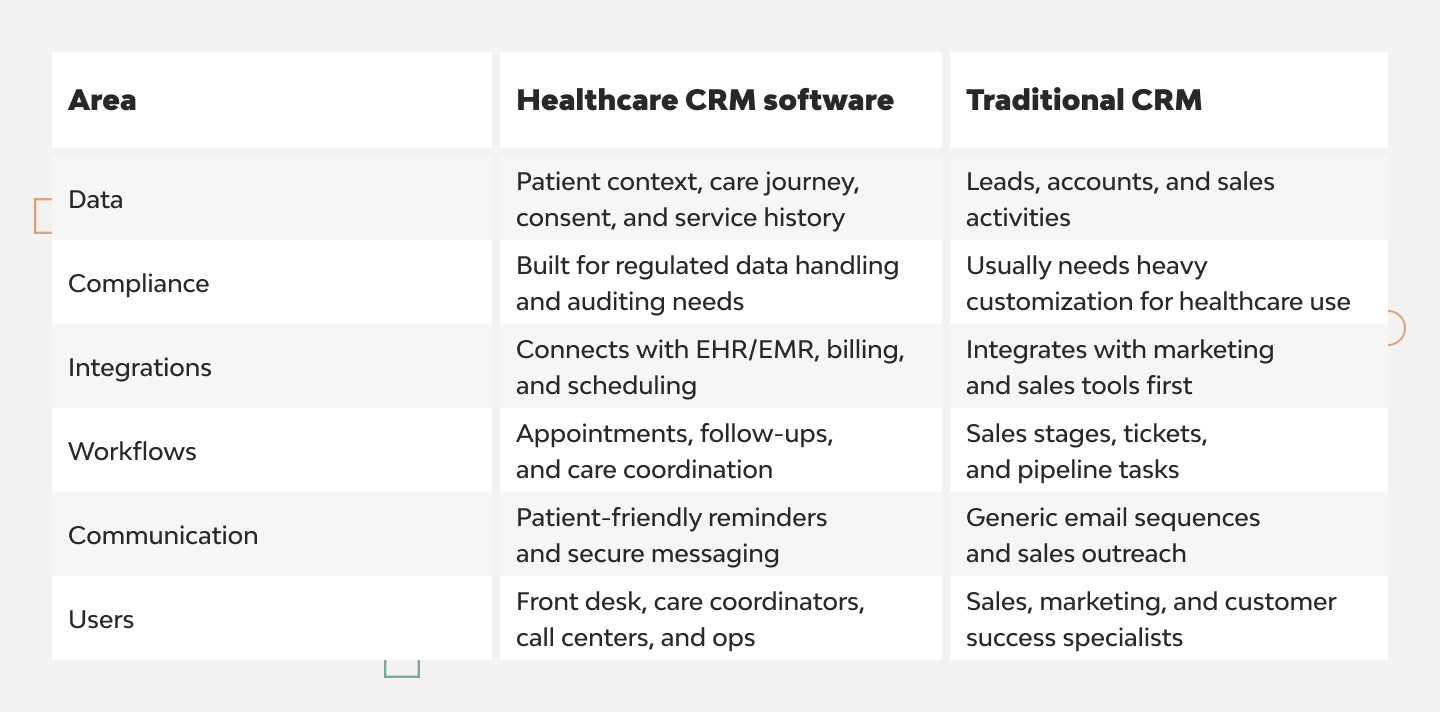
Here are the five best healthcare CRM options you can leverage right now.
Best for: Teams that invested in Microsoft and Dynamics 365.
Overview: Microsoft Cloud for Healthcare combines the capacities of Dynamics 365, Azure, Power Platform, and more related solutions to enable powerful CRM for the healthcare industry. Allows leveraging a reliable Microsoft ecosystem.
Key features:
Pricing: Starts at $95 per user, per month.
Best for: Complex care coordination and patient engagement at different scales.
Overview: Health Cloud syncs clinical and non-clinical data to provide full patient profile views and interoperability. It also supports HIPAA-compliant configurations and FHIR-based interoperability out of the box, with a BAA available from Salesforce.
Key features:
Pricing: Starts at $350 per user, per month.
Best for: Fast outreach, efficient lead capture, and simple automation.
Overview:
HubSpot’s ecosystem offers a separate stack of tools that can be used as patient-facing medical CRM software. HubSpot’s features help keep sensitive data secure while managing and nurturing patient relationships. Its lead generation benefits can translate into patient incentives.
Key features:
Pricing: Free core CRM, with paid plans starting at $9 per user, per month.
Best for: Teams focused on cost savings and HIPAA-compliant controls.
Overview: Zoho’s CRM healthcare offers HIPAA–oriented controls (for compliant deployment), encryption for PHI fields, access restrictions, audit logs, and templates—everything to keep things compliant and secure.
Key features:
Pricing: Must request individually.
Best for: Patient service desks and omnichannel support.
Overview: Zendesk’s CRM for healthcare providers drives patient support with customizable dashboards and delivers valuable insights by integrating with EHR and other data sources.
Key features:
Pricing: Starts at $19 per agent, per month.
Choosing healthcare CRM systems is easier when you evaluate real use, not just surface impressions. Use this checklist to compare healthcare CRM solutions.
Map your patient journey and your internal workflows first. Decide which teams will use the CRM and what metrics they should aspire to.
Confirm it supports scheduling, messaging, segmentation, and reporting at your current volume. Ask how it scales across locations, service lines, and new channels.
Make sure you can control access by user role and track sensitive actions. HIPAA outlines the rules for protecting ePHI, which can guide your data implementations.
Clinicians and front-desk staff need speed and clarity. A CRM vendor must ensure onboarding and help you test common tasks, like booking and data sharing.
Ask what the onboarding looks like and what support is included. Compare the total cost of ownership, not just the monthly fee.
Healthcare CRM software is moving from simple record-keeping to the smarter direction of next-best actions. The next wave of CRM in healthcare is about smarter coordination and less administrative work.
AI will summarize interactions and suggest next steps, like reminders or care gaps. It will also route requests to the right team faster. Some systems will personalize outreach using unified data, with less manual work.
CRMs will connect scheduling, video visits, and post-visit follow-ups into a single flow. The ultimate goal is to minimize patient touchpoints and track fewer lost messages.
Security efforts will become more proactive, with AI analytics and centralized access taking the lead. Soon, plain old checkbox compliance won’t be enough for CRM healthcare.
Expect more self-service, clearer communication preferences, and better accessibility. Patients will get more control and demand more healthcare mobile CRM capabilities.
For over 16 years, DjangoStars has delivered healthcare development services for clinics, hospitals, and HealthTech startups across the US and Europe.
DjangoStars focuses on EMR/EHR development, patient engagement systems, and legacy modernization, guaranteeing interoperability with HL7/FHIR and third-party platforms.
At DjangoStars, we explicitly position our software delivery in line with HIPAA and GDPR. To this end, we equip all healthcare CRM solutions we create with security controls, including encryption, audit trails, and role-based access controls.
Our healthcare CRM software cases include projects like:
With an NPS of 92.7% and over $1 billion in client funding, we are a proven technical partner, offering CRM for healthcare providers with an average 3.5-year partnership duration.
Hire experienced developers to build your next project with DjangoStars