Medical Device Software
Development Services
We offer custom software for medical devices to help healthcare providers streamline workflows, improve diagnostic precision, and deliver personalized care.
Why Choose DjangoStars for Medical Device Software Development
DjangoStars brings medical device software development expertise to projects in regulated healthcare environments. We develop software for connected devices and SaMD to support complex clinical workflows and ensure interoperability with existing systems.
-
DjangoStars has over 18 years of experience developing software for healthcare organizations and medical technology companies.
-
Our team builds Software as a Medical Device (SaMD) and applications that control or communicate with connected medical devices.
-
We develop software for FDA Class II/III devices and address IEC 62304 safety Classes A/B/C.
-
Our developers follow HIPAA, GDPR, FDA 21 CFR Part 11/820, MDR, and IVDR requirements throughout the development process.
-
We use HL7, FHIR, DICOM, XDS/XDS-I, ICD-10, and SNOMED CT to support data exchange between medical systems.
-
We connect medical software with EHR/EMR platforms, wearables, sensors, and IoMT devices to enable reliable data flow.
-
Our experts handles the entire development cycle, including QA, software validation, and regulatory documentation support.
Who We Develop Medical Device Software For
DjangoStars covers the full medical device software development lifecycle, from design and implementation to integration and technical support. We follow industry requirements to ensure user safety and data protection at every stage.
- Medical Device Manufacturers
- Healthcare Providers & Hospitals
- Digital Health Companies
- Healthcare Startups
- Medical Laboratories
- Blood Banks
- Research Centers
- Home Healthcare Providers
- Pharmaceutical & MedTech Companies
- Hospices, Nursing Homes & Other Care Facilities
Medical Device Software Development Services
Our medical device software experts assess your business needs, healthcare IT environment, medical equipment, and regulatory requirements to identify the right software approach. We then discuss the functionality, technology stack, and implementation plan with your team.
We develop custom medical device software and SaMD around your workflows and device specifications. Our programmers take healthcare regulations into account when working on the product.
DjangoStars developers integrate medical device software with EHR/EMR systems, healthcare applications, third-party tools, and native device software. We work through differences between these systems to achieve reliable, interoperable data exchange.
We monitor software performance and security to find out what needs fixing and resolve technical issues as they come up. Our developers handle regular updates and use these findings to continuously improve medical device software.
Types of Medical Device
Software We Develop
Our medical device software developers build standalone SaMD solutions and software that powers, controls, monitors, and connects medical devices. Based on the intended use and operating environment, our medical device software solutions include:
Software for
Medical Devices
Our team develops software that operates as part of medical device systems, covering device control, real-time monitoring, health data collection and analysis, and connectivity with healthcare systems.
In-Hospital Medical
Device Software
- Medical imaging systems
- Blood collection devices
- Smart carts
- Patient monitoring equipment
In-Home Medical
Device Software
- Smart inhalers
- Digital thermometers
- Home monitoring devices
- Voice-assisted healthcare devices
On-Body & Wearable Medical Device Software
- Smartwatches and fitness trackers
- Blood pressure and heart rate monitors
- Glucose monitors
- Insulin pumps
Software as a Medical Device (SaMD)
We build standalone software that performs medical functions while running on smartphones, tablets, PCs, and wearable devices.
- AI-assisted diagnosis and treatment planning
- Drug prescription and dosage calculation
- DICOM medical image viewing and analysis
- Disease monitoring and management
Our Successful Medical Device Software Projects
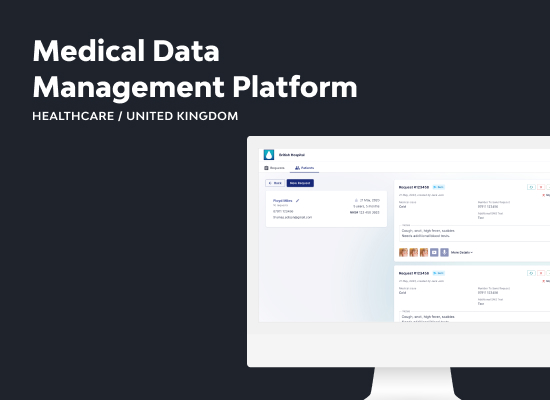
Medical Data Management Platform
Client:
A UK healthcare startup building a medical data platform for hospitals.
Challenge:
The team had a strong product idea but needed to turn it into a working MVP. They wanted to simplify how hospitals collect patient data, review requests, and prepare people for treatment.
Solution:
DjangoStars mapped the product flow and built a web platform for admins, doctors, and patients. It lets hospitals register users, collect forms, upload media, add doctor notes, filter requests, and manage patient data in one place.
Result:
Hospital teams can process patient requests faster and with less manual work. Doctors get the right information earlier, while patients receive a clearer, smoother path before treatment.
Key Modules for Medical Device Software
Mobile App
Mobile apps offer convenient access to medical device readings and SaMD data. Healthcare professionals check patient information on the go, while patients manage conditions using these medical device software development solutions.
Advanced Analytics
AI- and ML-powered analytics process data from connected medical devices and reveal patient health trends. Doctors use these patterns to evaluate medication effectiveness. They can predict disease progression and detect potentially dangerous symptoms early.
Cloud Platform
Cloud platforms collect patient vitals, diagnostic data, and treatment information from connected devices. Glucose monitors, pacemakers, and smart inhalers share readings with the platform. Staff handle configuration and monitoring to support device management and failure detection.
IoT-Based Medical Device Tracking
IoT tracking helps healthcare organizations locate complex medical equipment across different rooms. Staff reduce device search time and check usage records to support proper disinfection and sanitation. Technicians use device logs for remote maintenance.
Real-Time Health Monitoring
Medical device software lets teams continuously collect, store, and analyze health data. Blood glucose levels, heart rate, sleep metrics, and patient-generated data are available between visits. Clinicians use these records to automate clinical workflows and support ongoing health management.
Medical Device Software Use Cases
Remote Care & Telemedicine
We build medical device software to connect continuous remote patient monitoring with virtual care. By collecting health metrics from connected devices and sensors, the system gives healthcare professionals patient data through clinical systems.
Patient Self-Service
Our team creates SaMD and connected applications to help patients monitor health and manage chronic conditions. Mobile apps let them track lifestyle, sleep, and nutrition at home. They can also manage medical devices and update personal health data remotely.
Diagnostic & Treatment Assistance
Our team can develop software to assist with treatment and clinical procedures. By processing medical data from blood tests, MRI and CT scans, and X-rays, it supports faster, accurate diagnostics and other diagnostic workflows.
Measurement & Analysis
We create medical device software for measurement and analysis of substances, samples, and medical data. Lab technicians use it for laboratory workflows, compound analysis, and medication quality control.
Healthcare Facility Monitoring & Management
We offer solutions that connect medical equipment tracking with inventory and resource management. Staff check air and water quality, temperature conditions, infection risks, and other safety-critical parameters through facility environment monitoring.
Medication Management
We provide software for safe and accurate medication administration, including automated reminders and medication pumps. Teams also use it for drug interaction checks, adverse reaction tracking, medication storage, dispensing, and disposal monitoring.
Medical Device Software Integrations
Keep patient records automatically updated through integration with EHR and EMR software. Transfer data collected from medical devices, including vitals, measurements, analytical insights, and changes in a patient’s condition.
Automate routine workflows by connecting medical devices to hospital management systems. Centralize device monitoring and management to support the development of a connected smart hospital environment.
Set up integration with pharmacy systems to automate medication workflows. Use patient data from connected devices for automated medication workflows and to support medication dispensing, monitoring, and prevention of adverse reactions.
Bring accurate patient-generated data into virtual consultations through medical device integration. Give healthcare professionals access to readings for remote examinations, diagnostics, treatment assessment, and ongoing care.
Feed patient vitals and health data from connected devices automatically into RPM and clinical applications. Show real-time information and alerts about critical changes to medical staff.
Connect medical devices and sensors through integration to continuously track condition-specific health metrics. Share up-to-date data with clinicians and patients for ongoing disease management and treatment adjustment.
Advanced Technologies for Medical
Device Software Development
The DjangoStars team combines medical device software development expertise with advanced technologies to expand device capabilities, improve diagnostics and treatment, automate data processing, and support personalized patient care.
Our Medical Device SoftwareDevelopment Process
Requirements Gathering
& Planning
We identify business, clinical, technical, and regulatory requirements to define the software scope, then prepare specifications and an implementation roadmap for software development for medical devices.
Software Architecture
& UX/UI Design
Our team builds scalable medical device software architecture and turns everyday tasks of patients, clinicians, and other users into intuitive user journeys and interfaces.
Medical Device
Software Development
We develop secure, cross-platform medical device software and SaMD according to healthcare and medical device requirements.
Integration with Healthcare Systems & Devices
Our developers bring IoMT devices, wearables, and sensors into EHR/EMR systems and third-party healthcare applications using HL7 and FHIR.
QA, Verification
& Validation
We use continuous multi-level testing to find functional issues, backed by code reviews, software verification, validation, and security checks.
Regulatory Documentation
& Release
Our team prepares required technical documentation and gathers release evidence for FDA, CE, MDR/IVDR, HIPAA, and GDPR compliance.
Support & Software Evolution
We monitor software performance and security in daily use, resolve technical issues, and provide updates to continuously evolve the product.
Benefits of Custom Medical Device Software
Better Patient Outcomes
Lower Cost of Care
Higher Patient Engagement
Improved Software Reliability & Usability
Secure Health Data Management
Easier Maintenance & Evolution
New Business Opportunities
Cost & Timeline
Expect to invest $80,000–$750,000+ and allow 12–36+ weeks to build medical device software. The budget and schedule depend more on regulatory classification and the amount of evidence needed for approval than on how many features the product has.
Medical Device Software Development Cost
Medical Device Software
Development Challenges We Address
We guide the project through medical device compliance procedures and prepare the documentation for software clearance and certification. Our team checks the relevant FDA and MDR requirements.
DjangoStars uses an efficient delivery process to shorten time to market. We can launch an MVP in six months while maintaining the required software quality.
We handle integration with medical devices and SaMD solutions through flexible architectures. Our developers connect new device models and types with minimal rework.
Our team provides well-documented source code, tests, and project documentation. We arrange knowledge transfer so another vendor can take over maintenance and further development.