
Digitize critical banking operations with a CRM built for your business needs.
Turn to DjangoStars to start delivering smarter, more personalized financial experiences.

Today’s digital banking succeeds or fails on user experience. Nothing else matters as much. With 18 years and over a dozen cases in fintech, we at DjangoStars can say for a fact: modern financial clients expect near-instant response, omnichannel service delivery, and automated, seamless self-service.
Banking CRM software can enable all of that. Namely, Banking CRMs power customer-centric service delivery, support, and communication, which is so important when everybody demands personalization and engagement.
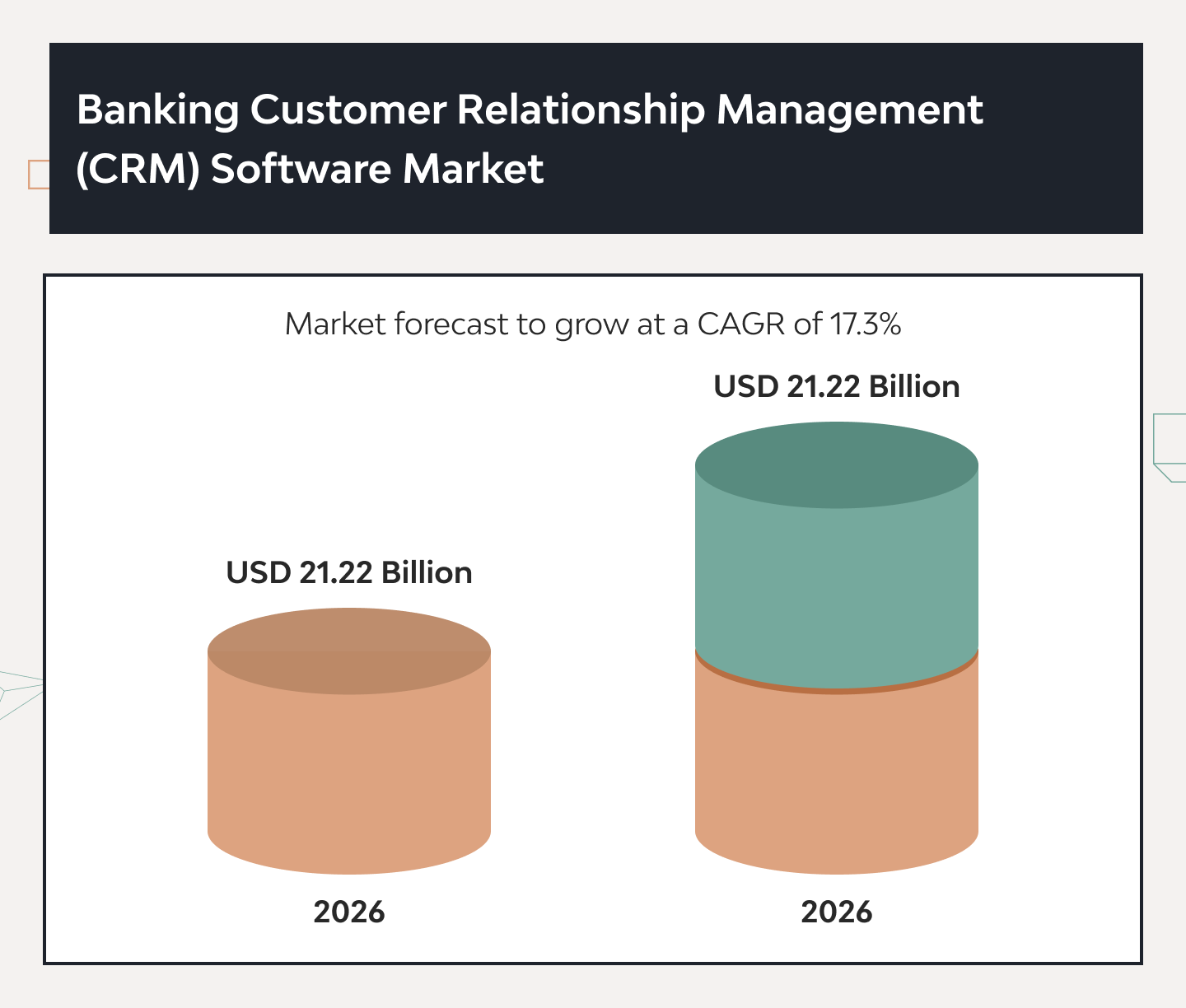
That’s probably why banks and financial institutions increasingly adopt CRMs to retain customers and stay competitive: the global banking CRM software market is growing rapidly, expected to go over $21 billion in 2026.
Banking CRM software is a specialized platform that provides tools for managing customer relationships in financial services. CRMs allow modern banks to collect customer information, related financial data, and actionable analytics in one place. They also offer features for organizing all the data, monitoring crucial business metrics, collaborating, and engaging customers.
Furthermore, CRM for the banking industry is compliance-ready, complying with all requirements for handling personal and financial data. They help keep regulatory requirements in check while gathering a wealth of metrics from multi-channel customer interactions and digital service features.
When implemented properly, a banking CRM centralizes customer data, unifies service departments, and automates a big portion of consumer-facing actions (e.g., promotions, cross-selling campaigns, data updates, etc.).
Using CRM in banking helps generate leads, attract new customers, and retain existing ones. Banks can use a CRM platform to unify all customer communication channels.
Banking CRM software helps collect data from multiple systems into a single profile. This allows banks to track customer actions, meet their preferences, and update the profile after each major interaction.
The analytical power of CRM in banking helps develop better service recommendations and be more valuable to customers. This naturally grows customer satisfaction and engagement rates.
Banking CRM software development helps digitize and synchronize departments through collaborative tools. This provides financial institutions with greater service consistency, with all staff members staying on the same page.
Banking CRM solutions help create complete customer profiles, with a history of interactions and touchpoint updates. Visualized dashboards, statistics, and built-in analytics give banks a 360-degree view of the customer persona.
Lead tracking, service pipeline visibility, and other banking CRM features help banks track every stage of the customer relationship, from initial contact to post-service retention. Sales and relationship teams can map the customer journey and optimize the service funnel as well.
Banking CRM software integrates mobile apps, call centers, branches, and social channels, centralizing all customer communication. This allows bank employees to access the same conversation history and context, so customers do not have to repeat themselves when switching channels.
Custom banking CRM software development enables banks to automate specific tasks and routines, e.g., onboarding, document collection, reminders, and follow-ups. CRMs can help minimize manual work, respond to inquiries faster, and reduce human errors.
Banking CRM solutions provide dashboards and reports that banks can use to monitor performance, measure service, and spot behavioral trends. Centralized customer data enables managers to make faster, more informed decisions and adjust strategies when needed.
Banking CRMs increasingly use AI to recommend products, predict customer needs, and direct the best next step in a conversation. AI helps keep conversations relevant, engage customers, and deliver more personal service over time with zero extra pressure on existing departments.
Banking CRM software supports compliance by recording customer interactions, securely storing data, and controlling who can access sensitive information. These safeguards help banks meet regulatory requirements and cut operational risk, using strong compliance tools create a more reliable environment for both employees and customers.
In our own professional experience, the CRMs we have built enabled the leading broker platforms to host over 150 B2B partners and increase performance at the same time. We’ve seen banking CRM integration or custom development bring more benefits.
Using CRM in banking and financial services gives banks a fuller view of their customers—how they usually react, which channels they use, and when. By analyzing transaction history, preferences, and interaction data, banks can anticipate needs and offer tailored solutions.
Banking CRM systems offer a shared data environment where teams across support and operations can automate routine tasks, such as data entry, follow-ups, and reporting. This allows bank employees to shift some focus from administrative work to high-impact customer interactions and technical advisory.
Institutions can leverage CRM in banking to boost marketing efficiency and drive more conversions through data analytics and insights. For instance, by tracking and analyzing customer behavior and financial patterns, banks can pick the perfect moment to offer loans, credit products, or investment services.
Implementing a CRM for the banking industry enables compliance with regulatory requirements and creates clear audit trails with detailed records of customer interactions, approvals, and transactions. CRM systems can also help detect risk in customer activity patterns, enabling banks to recognize unusual behavior early and reduce fraud exposure.
Banking CRM systems enable consistent service and personalized experiences across all touchpoints, which are essential for instilling and retaining customers’ trust. Positive experiences also turn customers into brand advocates—satisfied clients will probably recommend your services, leave positive feedback, and push organic brand growth through word-of-mouth.
Banking CRMs help segment users by behavior, lifecycle stage, and financial goals, enabling banks to tailor communications and offers with high precision. As a result, the institution grows capable of providing personalized experiences for millions of users at once, engaging customers individually on a massive scale.
Banking CRM systems engage users through automation, chatbots, and integrated communication channels—customers can access services, get answers, or resolve issues at any time. At the same time, CRM keeps all interactions connected and contextual, enabling customers to switch between mobile apps, call centers, or branches seamlessly.
Banking CRM solutions use AI to process large volumes of transactional, behavioral, and interaction data in real time. Instead of relying solely on historical reports, banks can identify patterns, predict customer needs, and detect early signals such as churn risk or product interest.
Banking CRM can integrate AI-driven assistants that instantly handle customer requests, answer common questions, and guide users through staged processes. And they perform without downtime, resolving a large share of routine interactions without human help.
AI in banking CRM software development can automate entire workflows—for example, initiating onboarding steps, flagging risks, or recommending follow-ups automatically. It also minimizes human error and helps make sure you never miss compliance checks or customer communications.
Based on customer data insights and statistical tracking, a banking CRM can help tailor highly personalized experiences, with an AI model recommending the right products and sending timely alerts. Thanks to AI, you can segment customers at any scale, autonomously, according to their profiles and demographics.
Many banks still run legacy digital infrastructures that may not have the means to integrate. This is why it’s so important to prioritize compatibility in banking CRM software development.
It can be a major challenge to gather customer data from core banking systems, mobile apps, and support channels. It’s crucial to find a way to standardize and unify data sources.
Financial institutions must comply with strict regulations. You may invest further in a CRM’s auditability and reporting requirements.
Banking CRM software development must necessitate strong data protection. Security breaches can leak personal data and cause serious financial and brand damage.
Employees may struggle to start using new systems right away. Make sure to plan user training and change management.
Custom banking CRM software development focuses on a bank’s exact processes, products, and customer journeys, rather than forcing the organization to adapt to predefined logic. This is especially important in banking, where workflows such as lending, onboarding, or compliance can differ significantly across institutions.
A custom approach also provides long-term flexibility: banks can evolve the system as their business grows, add new features, and integrate deeply with internal systems.
Banking CRM solutions based on ready-made platforms are a faster and more predictable path to implementation. These systems come with pre-built features, industry best practices, and vendor support, allowing banks to launch quickly and start seeing value sooner.
However, platform-based CRMs can have limited customization, which may require an institution to re-adjust workflows, cut down on features, or switch subscriptions over time.
A hybrid model allows combining platform-based CRM foundations with custom-built modules. This way, you deploy a new system faster while customizing and scaling the CRM as you go, based on direct workflow needs.
It’s a balanced approach that can minimize risk compared to fully custom development while avoiding the faceless, out-of-the-box solutions.
Overview: An enterprise-grade CRM for financial institutions that integrates with tools of the Microsoft ecosystem. Microsoft’s CRM offers extensive analytics, automation tools, and big dashboards that visualize a wealth of metrics.
Key features:
Pricing: $210–$300 per user, per month.

Overview: One of the best-known banking CRM systems with an extensive ecosystem of integrations, proven AI features, and simple scaling. Salesforce offers a feature-rich platform for banking, wealth management, and insurance, with detailed client views.
Key features:
Pricing: $325–$350 per user, per month, based on the plan.

Overview: A no-code platform for rapid deployment and customization of banking CRM systems with the help of agentic AI. Creatio offers an easy entry point into banking CRM software adoption, with ready-made customer management tools and flexible settings.
Key features:
Pricing: $25–$85 per user, per month.

Overview: A CRM for the banking industry with extensive automation and integration features. Zoho offers a well-known ecosystem with a dedicated financial suite that helps organize critical processes, from invoicing and accounting to data management and analytics.
Key features:
Pricing: €249 per organization (10 users), per month, plus paid add-ons.

Overview: Another renowned ecosystem of digital services with a suite of tools for small to mid-sized financial institutions. HubSpot offers some of the best banking CRM software for connected, collaborative workflows and centralized data sharing.
Key features:
Pricing: €9–€150 per seat, per month.
Primarily, banking CRM systems integrate with a bank’s core platforms to access account details, balances, and transactions in real time. This helps synchronize data, enabling employees to always work with up-to-date customer information.
Finance-oriented CRMs connect with payment gateways, card processing systems, and loan management platforms. This allows banks to monitor transactions, loan applications, and repayment statuses right in the CRM.
Specialized banking CRM features support integration with KYC, AML, and risk management tools to automate compliance. Such tools help reinforce protection and score risks across customer profiles.
CRMs integrate with document management systems and digital identity verification tools. You can verify uploaded documents in addition to user identities.
CRM for the banking industry leverages APIs to connect with external fintech services. These may include credit scoring, payment providers, or investment platforms.
Start by clearly figuring out why you are implementing CRM in banking: are you looking to improve retention, speed up onboarding, or boost cross-sell rates? Make sure to set clear, measurable objectives.
You need more than just comparing features to select the right banking CRM software—it must also align with your business model and regulatory needs. Pick a platform that’s scalable, user-friendly, and compliance-ready.
Banking CRM solutions must be deeply integrated with core banking systems, payment platforms, and compliance tools to deliver real value. Without integration, CRM becomes isolated, forcing teams to reconcile data across systems manually.
A CRM should reflect how your bank actually operates. Customize workflows, service pipelines, and interfaces to align with the real business processes in your institution.
User adoption determines the CRM’s overall efficiency. It’s important not only to train for basic functionality but also to show employees how the system fits into their daily work and helps them achieve better results.
CRM implementation requires continuous post-launch evaluation and improvement. You should track key metrics such as usage rates, customer engagement, and process efficiency.
DjangoStars provides a full range of custom banking software development services for projects of any scale, purpose, and complexity. We offer:
Hire experienced developers to build your next project with DjangoStars