How Cloud Supply Chain is Transforming Logistics


Modern logistics faces numerous challenges in its shop-floor activities, among which are labor shortages, infrastructure limitations, regulatory compliance, rising costs, sustainability, supply chain disruptions, technology integration, limited data visibility, and more. Cloud supply chain can help address the lion’s share of these problems. And forward-looking C-suite managers across logistics organizations are well aware of the growing role of cloud computing in supply chain. In 2022, the size of the cloud supply chain market was estimated at $9.13 Bn, and its projected value is expected to hit $36.98 Bn by 2030.
What makes cloud supply chain management solutions so popular? Hardware and network devices become software abstractions; you don’t need to care about their maintenance. Small or huge companies may gather, operate and store their data more accessible with cloud solutions. To make it work, they don’t need old server rooms with ‘No entry’ signs and many kilometers of wires. Seeing such boons, over 75% of companies will adopt cloud computing services by 2026 as the fundamental underlying platforms for digital transformation.
Let’s uncover how the integration of the cloud in the supply chain contributes to streamlining operations and enhancing efficiency.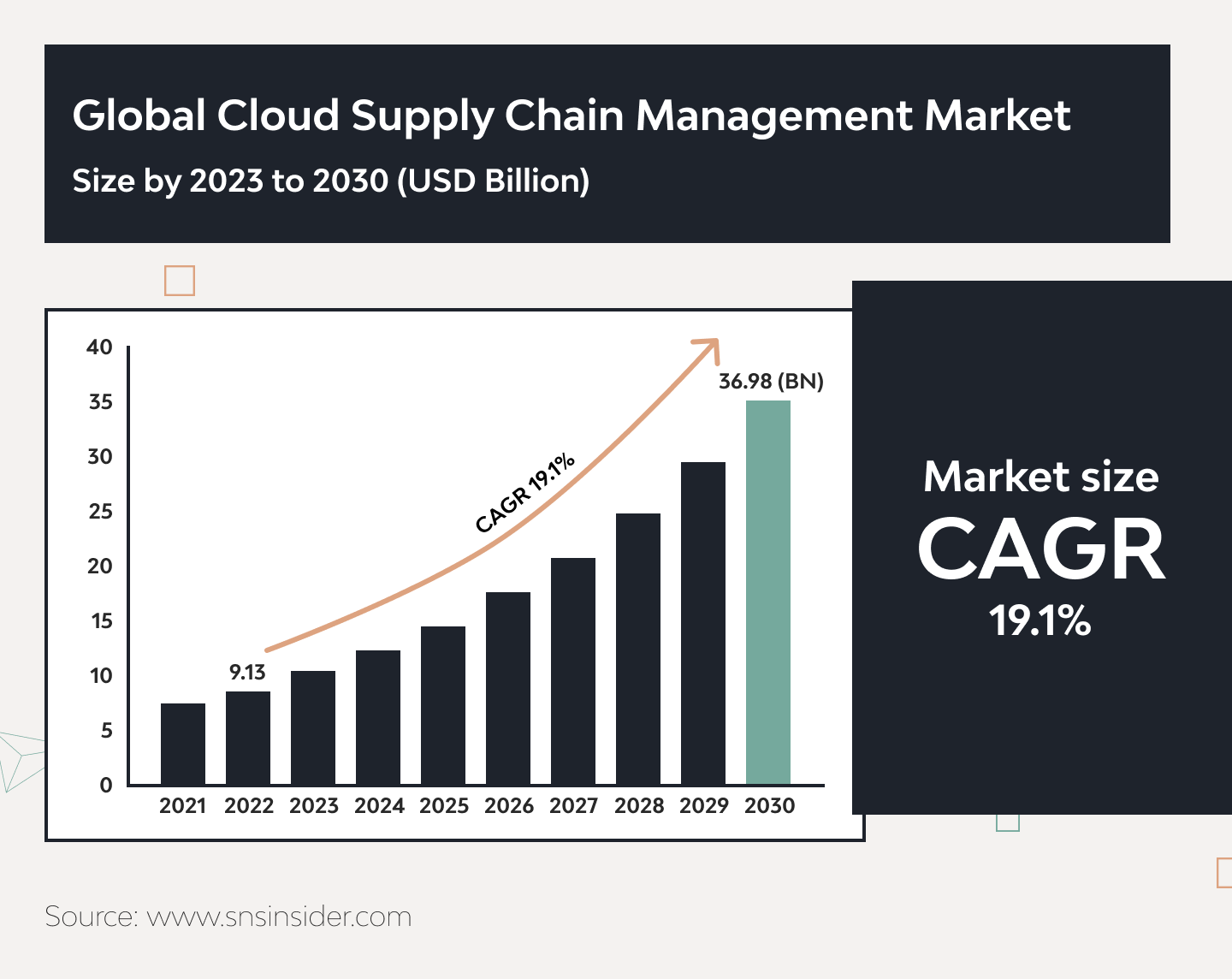
What is Cloud Supply Chain?
Traditional supply chain management (SCM) encompasses a broad range of operations related to warehousing, inventory management, replenishment, and delivery, implemented with the help of specialized software. Cloud supply chain management enables logistics companies to dramatically streamline and facilitate their workflows by moving tools and infrastructure from on-premises facilities to the cloud.
Leveraging cloud computing in supply chain allows businesses to automate their functions, access relevant data from anywhere via electronic data interchange (EDI), enjoy comprehensive data analytics to improve decision-making, create information backups to prevent its loss, enhance their ERP systems with cloud-based intelligent technologies, and more.
What assets does the onboarding of cloud computing in supply chain management yield to logistics enterprises?
Benefits of Cloud Supply Chain
For businesses, cloud supply chain systems unlock new beneficial possibilities.
1. Real-time visibility and tracking
Stored data is available from anywhere in the world. It will allow different company branches to work in the same space regardless of their location. All supply chains and required data will be visible and available immediately. And this will help better track, analyze, and optimize supply routes, prices, terms, and conditions.
According to Accenture’s survey, 21% of supply chain executives have implemented cloud-based logistic solutions across their entire processes. 97% of them have at least 3/4 of their supply chains running in the cloud. Decision-makers admitted that cloud adoption led to a 26% boost in demand forecast accuracy, reduced operating costs by 16%, and provided a 5% increase in revenue growth and profitability.
2. Enhanced collaboration
Thanks to cloud supply chain software, companies in the industry can integrate various workflows related to planning, procurement, and shipping into a cohesive system, keeping all stakeholders on the same page. Besides, they can utilize a set of cloud-based communication methods and tools (instant messaging, voice over internet protocol, video conferencing, document sharing and editing, you name it) that prevent departmental silos, minimize miscommunication, provide real-time collaborative planning, and ensure quicker problem resolution through coordinated effort.
3. Cost savings and efficiency
Cloud providers offer flexible pricing plans, enabling users to pay only for the resources they utilize and avoid splurging on setting up and maintaining costly on-premises servers, infrastructure, and hardware.
Also, cloud-based supply chain solutions act as major efficiency boosters since they ensure real-time process visibility, rapid bottleneck detection, predictive analytics in supply chain management, improved communication and collaboration, automation of manual and redundant tasks, minimization of human-factor errors, as well as AI-driven demand forecasting, inventory optimization, and knowledgeable decision-making.
4. Scalability and flexibility
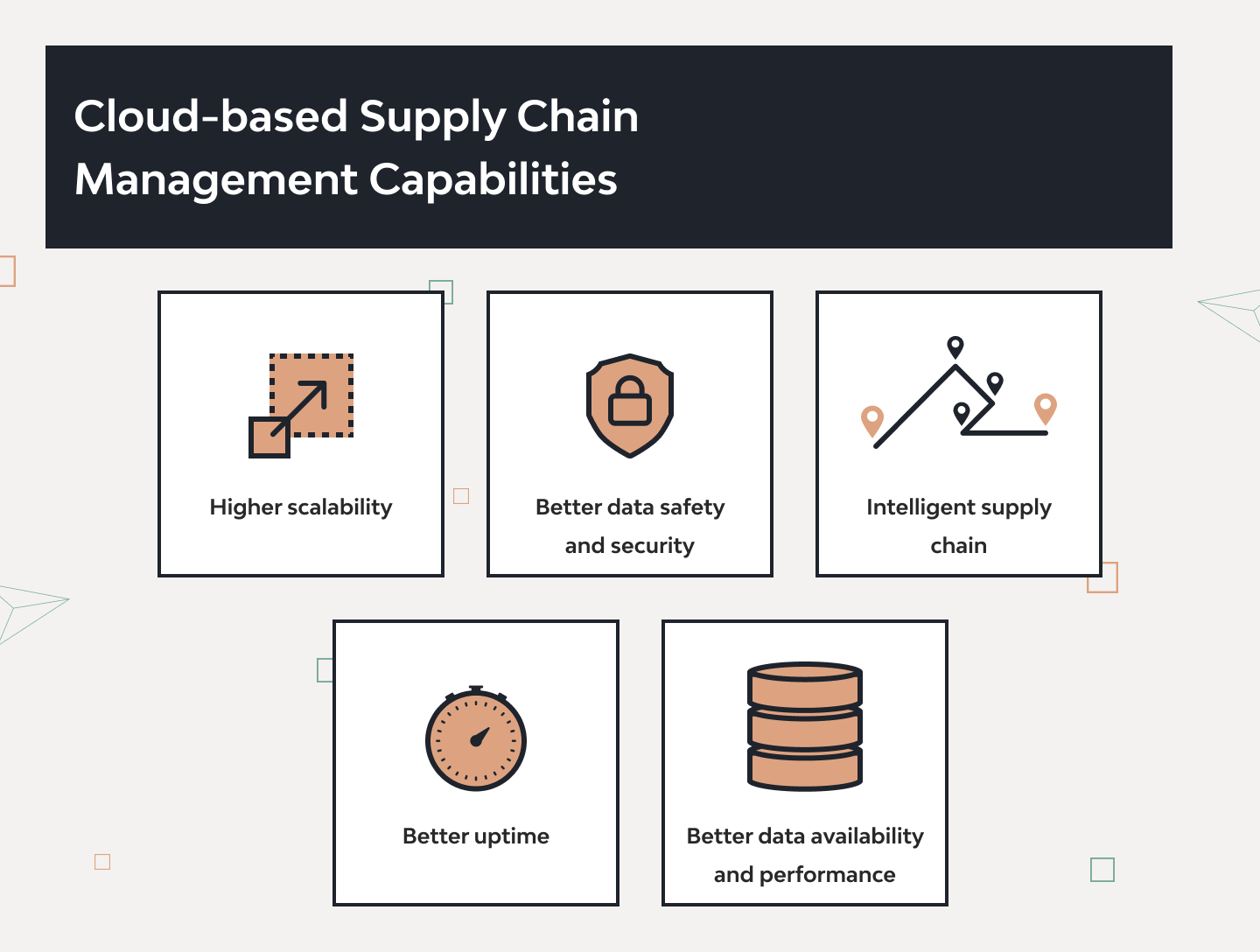
Physical data centers are not flexible. They have strict capacity limits that cannot be exceeded. If the demand for an app or service has rapidly grown, it may lead to software errors, increased risks of hardware breakdowns, and poor product performance. Even top system administrators will not solve these problems fast.
The role of cloud computing in supply chain allows it to deal with these issues in no time. A customer pays only for actually used capacities. But what is more important, there is no upper bound. During peak hours with extremely high loads, your supply chain will work steadily without delay or errors.
Thus, cloud solutions are utterly scalable. Using them, a client may set it up in real-time and not depend on the hardware.
5. Improved customer experience
Cloud supply chain platforms provide complete visibility into processes and create a seamless experience across multiple channels (mobile apps, websites, brick-and-mortar facilities, social media, etc.), allowing customer support agents to get a 360-degree view of both the clientele and pipeline operations. In this way, businesses ensure consistency and agility of their services, swifter order processing, stockout prevention, and shorter delivery times. Moreover, companies can leverage the advanced analytics capabilities of cloud supply chain solutions to personalize their services based on customer behavior and preferences.
How do these benefits of cloud computing in supply chain management transform logistics?
Top 5 Cloud Supply Chain Use Cases
Cloud SCM software is most effective when employed in the following applications.
1. Managing logistics
This is the primary use case of cloud-based supply chain management software. Versatile logistics pipeline processes that can be essentially streamlined and facilitated by hydrating the cloud include:
- Allocating vehicles to certain tasks
- Managing and prioritizing orders
- Generating shipping routes and optimizing the existing ones in real-time
- Automatically handling red tape (filling out invoices, receipts, compliance forms, and more)
Cloud facilities enable all departments within a logistics organization, and even across different enterprises, to access the unified data bank in the cloud and collaborate effectively, uniting all workflows into a coordinated, transparent system.
2. Automated inventory management
Traditionally, inventory management has been an extremely time- and effort-consuming assignment, especially during peak periods like holiday seasons, back-to-school surges, and industry-specific cycles (for instance, spring in agriculture or flu outbreaks in healthcare). Yet logistics companies should continually ensure that all necessary goods are available to customers and delivered regularly to physical outlets.
Cloud supply chain tools are indispensable in such cases. They allow businesses to automatically reorder items whose stock is running low, track in-transit products, manage multi-location operations, forecast demand, generate granular reports on turnover, sales, and profits, and more.
3. Data-driven forecasting
The ability to anticipate future sales enables logistics organizations to adjust their routines, scale up departments, and direct efforts to areas likely to experience a spike. Such predictions are possible only if managers can get hold of relevant data and spot patterns in their dynamics.
Cloud supply chain management platforms can derive information from various sources (CRMs, online sales portals, wholesale suppliers’ reports, etc.) and execute their in-depth analysis. With all historical and current trends in the niche at their fingertips, logistics companies can build accurate demand predictions and introduce necessary changes in their pipeline operations weeks and even months before a spike occurs.
4. Procurement and sourcing optimization
To mitigate the effects of possible supply chain disruptions, organizations should go the extra mile to diversify their procurement and sourcing. Cloud computing tools are a good crutch in this endeavor. They help keep track of communications with various partners, serve as a single source of truth for such operations, eliminating errors and duplications, allow for the comparison of raw materials and finished goods prices that different vendors offer, and ensure visibility into the geographical distribution of locations from which products are delivered. Moreover, these tools can be configured to enable the organization to automatically switch to another supplier whose current pricing and shipping conditions are more attractive.
5. Maintenance management and equipment breakdown
When delivery vehicles or assembly lines go out of order, the entire supply chain stalls. Cloud-based solutions can be used to prevent such emergencies by creating a one-stop-shop maintenance dashboard. It will present information from sensors and IoT devices regarding mechanical damage, fuel leaks, temperature anomalies, pressure drops, and other vital parameters responsible for the adequate functioning of hardware and mechanisms. Spotting malfunctions in time, employees can react to them promptly and fix equipment on short notice, saving logistics companies a pretty penny. Plus, such solutions are highly instrumental in envisaging regular maintenance sessions and automating routine maintenance tasks.
What supply chain software excels at these jobs?
3 Best Cloud Supply Chain Software Solutions: Brief Review for Clients
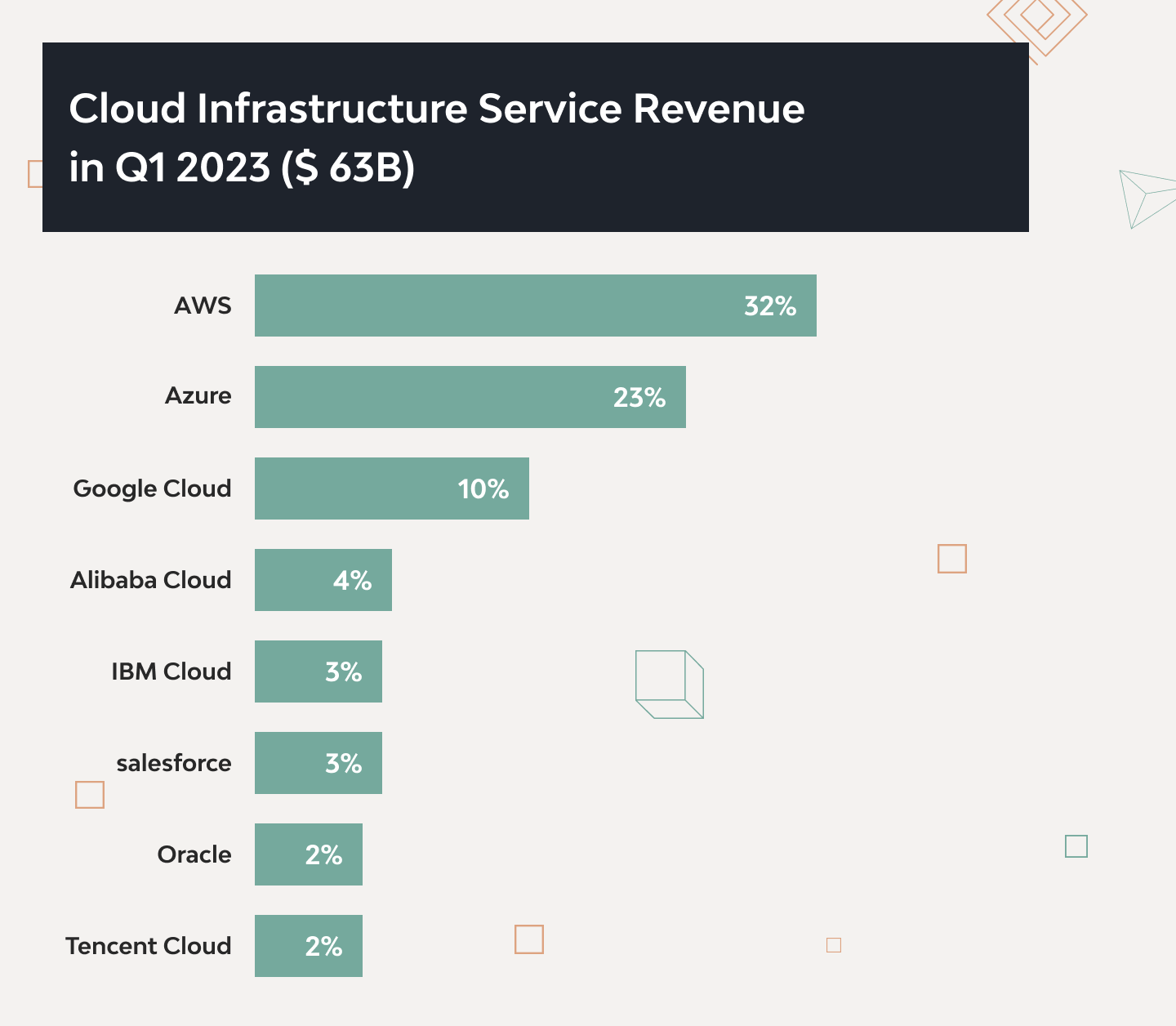
According to Statista, 65% of cloud-based services are dominated by three corporations — Amazon, Microsoft, and Google — which provide comprehensive solutions for all types of businesses, including supply chain management. The emerging integration of generative AI further advances predictive capabilities and optimizes operational efficiency.
Indeed, the most extensive systems are fine, but I recommend paying attention to specialized services that provide solutions exactly for cloud supply chain management.
Over 150 companies worldwide offer services for supply chain management in the cloud: point solutions, global processes, or full cloud integration.
According to G2’s review, there are three top cloud-based logistics solutions that have the highest scores among all the others: FreightWaves Sonar (4.5 stars), Magaya Supply Chain (4.5 stars), and Cargo Wise (4.3 stars). Let’s take a glance at them:
FreightWaves Sonar
Sonar is one of the leading freight forecasting platforms worldwide, with a complete view of everything moving in the global freight economy.
Its clients get reliable real-time insights and actionable intelligence. They also can benchmark, analyze, track, and predict the global supply chain by trucking, rail, ocean, and air. Users can easily monitor all the elements impacting the freight market – trucking spot and contract rates, fuel, demand, capacity, volumes, seasonality, weather, risk management, equipment values, etc.
Magaya Supply Chain
Magaya automates repetitive manual tasks in logistics. The service can be used as separate point solutions for particular needs or as a full-fledged independent cloud-based logistics platform.
This cloud-based supply chain management software helps control all logistic operations components: shipping, warehousing, tracking and visibility, rates, quotes, accounting, and compliance with a single, data-driven system.
CargoWise
CargoWise is a deeply integrated cloud supply chain platform designed to make international trading easier.
It helps clients to execute complex transactions even in such challenging areas as cross-border compliance, freight forwarding and rating, international e-commerce, landside logistics, and warehousing. Also, it has a flexible database that simplifies operations between multiple users, countries, and currencies.
How to Implement Cloud Supply Chain: 5 Main Steps for Businesses
You can successfully harness cloud-based logistics solutions only if you follow a well-thought-out implementation roadmap.
Step 1. Develop a cloud strategy
Such a strategy should contain clear goals you want to achieve by hydrating the cloud, detailed guidelines with major milestones, governance and risk management policies, KPIs that will enable you to evaluate the success of the mission, the list of personnel responsible for implementation, application modernization needs, scalability potential, and the budget allocated to accomplish the procedure.
Step 2. Select the right cloud provider
While choosing a vendor for your future cloud supply chain system, you should steer by the functionalities you need (inventory management, transportation management, demand planning, etc.), consider integration capabilities extended by the provider to let the solution play well with your existing ecosystem, and opt for the tools that operate according to the pay-as-you-go model where your expenditures are directly linked to the resources you use.
Step 3. Plan the migration
An efficient cloud supply chain migration plan should include the adequate assessment of the resources to be transferred to the cloud, the preferable migration approach (rehosting, refactoring, rearchitecting, etc.), the type of cloud to move to (public, private, or hybrid), the expected timeline, responsibilities of employees, data migration details, backup methods and security considerations, risk mitigation mechanisms, and post-migration optimization.
Step 4. Integrate and deploy
Integration steps ensure that all elements function properly after migration. These encompass dependency management, data synchronization, and network configuration. During the deployment phase, you should prepare the production environment within the cloud infrastructure, utilize automated CI/CD pipelines, provide a seamless switch from the legacy system to the new one, and test the cloud-based logistics software to validate its rock-solid security and smooth performance.
Step 5. Train users and monitor performance
Employees who will leverage the new system should be taught to use it through personalized learning paths, receive hands-on practice, and be able to turn for support. You should also establish straightforward success metrics and set up feedback loops to monitor the performance of both the solution and personnel who handle it.
When hydrating the cloud, it is mission-critical to realize what typical roadblocks and bottlenecks you will face along the way.
Challenges in Cloud Supply Chain Adoption
As logistics companies harness cloud supply chain systems, they encounter the following common pitfalls.
1. Data security and compliance
You should protect sensitive data from unauthorized access both during migration and when the new solution is in use, since cloud applications often become a target for cyber attacks and malware threats. Besides, while opting for a cloud provider, you should make sure it has a robust compliance policy in place to guarantee your adherence to data protection regulations.
2. Integration with legacy systems
Cloud computing in supply chain relies on disruptive technologies that may not align with the obsolete software your organization utilized in its on-premises infrastructure. You should envisage a deep overhaul of old applications and systems and ensure their interoperability within the cloud environment. Such tasks are particularly daunting when you have to orchestrate several cloud environments run by multiple vendors.
3. High implementation and vendor costs
Any state-of-the-art software is a big-ticket item, and supply chain solutions are no exception. However, you can avoid paying through the nose by moving only vital applications to the cloud, leveraging automated migration tools, utilizing only right-size resources, and harnessing flexible pricing models. To understand what you are up to expenditure-wise, use the cloud pricing calculators provided by the most popular vendors.
4. Vendor dependency and interoperability issues
Vendor lock-in can be addressed by opting for a multi-cloud or hybrid-cloud approach, prioritizing open standards, ensuring data portability, and leveraging open-source technologies. Interoperability problems can be mitigated by adopting loosely coupled software architecture, implementing API-driven integration, leveraging third-party systems, and establishing robust data governance policies.
You can successfully overcome these obstacles if you partner with a seasoned company that will help you with cloud supply chain onboarding.
How Can DjangoStars Help You Adopt the Cloud across the Supply Chain
What are the two major things to look for in a software company to entrust the development and implementation of a cloud supply chain system? First, it should have professional expertise in logistics solutions. Second, its specialists should have in-depth competence in cloud technologies. DjangoStars ticks both boxes.
During 16+ years of our presence in the software outsourcing market, DjangoStars’ vetted developers have tackled numerous projects of varying scope and complexity, enabling us to enter the Fortune 500 list of logistics industry clients. Our readiness to meet customers halfway in all partnership aspects, flexible cooperation models, meticulous attention to detail, and uncompromised quality of the final outcome have earned us numerous positive reviews from satisfied clients.
Get in touch with DjangoStars to elevate your logistics pipeline to a new level and enjoy the benefits of cloud computing in supply chain.
- What does supply chain cloud computing look like?
- Cloud computing solutions use remote data centers and allow your logistics data to be managed effectively. It’s possible due to storing all data in one location without dedicated servers. Moreover, many services offer solutions strictly for logistics operations that consider all variables and significantly improve supply chains.
- How is cloud computing relevant to my supply chain?
- Cloud computing simplifies all data-related calculations, works with assorted information more precisely and accurately, and allows better analysis and improvement of the supply chain in considering ever-changing conditions in the global market.
- What are the benefits of a supply chain cloud?
Here are the main benefits of cloud-based supply chain solutions:
- Reducing capital expenses and operating costs.
- Increasing efficiency and sustainability of all logistic processes.
- Unlimited scalability.
- High customizability: from point to full-fledged solutions.
- Always up to date.
- How to start a cloud-based supply chain transformation?
- Search for a cloud-based system that perfectly suits all company requirements and strategies. There are plenty of solutions designed for logistics companies; choose yours.
- What is the future of cloud in logistics?
- Cloud computing will continue to shape the contours of logistics tomorrow and beyond, ushering in greater warehouse automation, paving the way for deeper AI and predictive analytics involvement, supporting emerging technologies like blockchain, and propelling the industry towards smart cities and sustainable practices.
- Is cloud supply chain secure?
- Cloud providers go the extra mile to ensure the security of their infrastructure. However, the security of applications and data in the cloud is the total responsibility of the user. The latter must see to it that human errors, misconfigurations, third-party dependencies, and multiple integrations don't create vulnerabilities or security gaps.
Hire experienced developers to build your next project with Django Stars